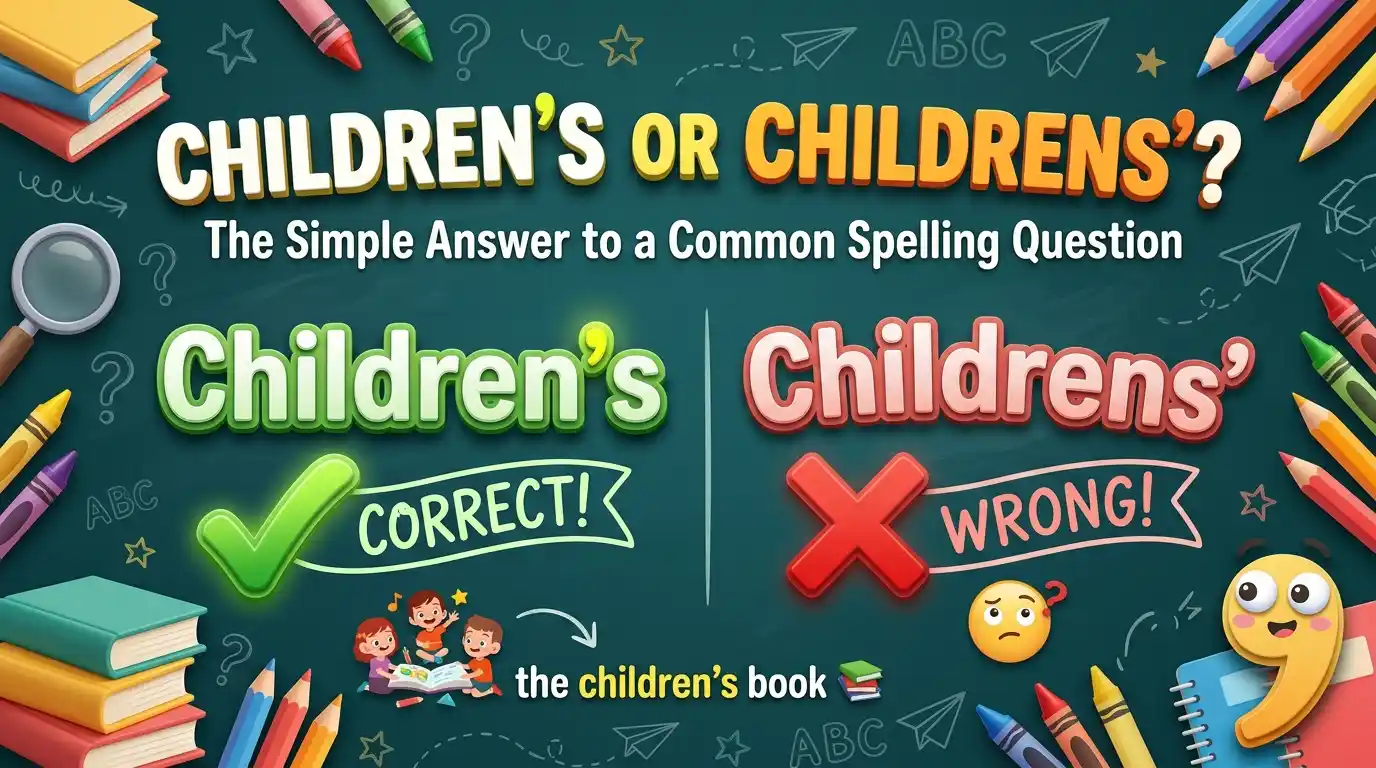
You are typing a note about kids. You stop. Is it children’s or childrens’? You are not alone. Many people search this question, and the answer is short. Children’s is correct. Children’ s are not.
So why does the doubt exist? Most plural words end in s. For those words, we put the apostrophe after the s. Think of dogs’ or teachers’. People copy that rule. But children are different. It is already plural, and it does not end in s. That one fact changes where the apostrophe goes.
Another worry is British and American spelling. Many words differ between the two. People ask if this one does too. It does not.
This guide gives you a quick answer first. Then it explains the history, compares the variants, lists common mistakes, shows real examples, and answers your questions. The words are simple. You can read it in five minutes. By the end, you will never second-guess children again, If you write emails, school notices, news posts, or book titles.
Children’s or Childrens’ Quick Answer
Children’s is correct. Children’ s is wrong in both American and British English.
The rule is simple. Children is a plural word that does not end in s. So you add apostrophe + s to show ownership.
- The children’s book is on the table.
- We visited a children’s hospital.
- This is the children’s menu.
- The school built a new children’s playground.
A quick test: say the phrase as “of the children.” If it fits, write children’s. “The toys of the children” becomes “the children’s toys.”
Use an apostrophe after the s only when the plural already ends in s. That is why we write kids’ menu and teachers’ lounge, but a children’s menu.
The Origin of Children’s
The word children is old. In Old English, the plural of child was cildru. Over time, the ending changed to -re and then -ren. By the Middle Ages, speakers had also added -en, the same ending found in oxen. So children is a double plural. It already says “more than one” without an s.
The apostrophe came later. Old English showed ownership with an -es ending. Over the centuries, the e dropped out of speech. Printers in the 1500s and 1600s began to mark the missing letter with an apostrophe. By the 1700s and 1800s, writers settled on the modern rules we use now.
The core rule did not change: add apostrophe + s to a singular noun, or to a plural noun that does not end in s. Add only an apostrophe to a plural noun that ends in s.
Why the confusion exists:
- Most plurals end in s, so people expect s’ every time.
- Children break the pattern, like men’s, women’s, and people’s.
- Some people hear the sound “childrens” and add the apostrophe at the end by habit.
So the mistake comes from an English rule applied too widely. It does not come from a spelling difference between countries.
British English vs American English Spelling
There is no British or American split for this word. Both write children’s. The apostrophe rules for possessives are the same in the UK, the US, Canada, Australia, and India.
Spelling differences do exist for other words. Noah Webster pushed simpler American spellings in the 1800s, such as color and center. But he did not change how the possessive apostrophe works.
| Word or phrase | American English | British English | Same or different? |
| Possessive of children | children’s | children’s | Same |
| Possessive of women | women’s | women’s | Same |
| Possessive of people | people’s | people’s | Same |
| Possessive of kids | kids’ | kids’ | Same |
| Possessive of teachers | teachers’ | teachers’ | Same |
| Color | color | colour | Different |
| Center | center | centre | Different |
| Defense | defense | defence | Different |
| Childrens’ | wrong | wrong | Wrong in both |
Takeaway: if you see children in a UK or US text, it is a typo, not a regional style.
Which Spelling Should You Use?
Use children every time. Your audience does not change the answer.
- US readers: children’s. Style guides such as AP and Chicago agree.
- UK and Commonwealth readers: children’s. Oxford and other British guides agree.
- Global or mixed readers: children’s. It is the one form every English reader accepts.
- Search and SEO: use children’s in titles, headings, and body text. Search engines read the correct form as the main one.
One exception to watch: some brand names, street signs, and official titles drop the apostrophe. When you write a proper name, copy the official spelling exactly. In your own sentences, use children’s.
Common Mistakes with Children’s
Most errors come from one habit: adding s’ to every plural. Here are the usual ones.
| Mistake | Correct form | Why |
| childrens’ | children’s | Children do not end in s, so use apostrophe + s. |
| children (to show ownership) | children’s | No apostrophe means no ownership. |
| childrens (as a plural) | children | Children is already plural. |
| children’s | children’s | Never double the s. |
| children’ | children’s | The s is needed after the apostrophe. |
| child’s | child’s or children’s | Child’s is one kid. Children’s is many. |
| the children’ s room | the children’s room | Same fix: apostrophe before the s. |
| the kid’s menu (many kids) | the kids’ menu | Kids ends in s, so the apostrophe goes after it. |
Mix-up to avoid: child’s means one child. Children means more than one. “The child’s toy” is one kid’s toy. “The children’s toys” belongs to a group.
Children’s in Everyday Examples
- “Please send the children’s forms by Friday.”
- “Our team is planning a children’s reading hour next month.”
News headlines
- “City opens new children’s hospital wing.”
- “Children’s book sales rise this year.”
Social media
- “I loved the children’s story time at the library today!”
- “Looking for a good children’s bike. Any tips?”
Formal writing
- “The charity protects children’s rights across the region.”
- “The report studies children’s access to clean water.”
In every case, the apostrophe sits before the s. Casual or formal, the rule stays the same.
Children’s Google Trends & Usage Data
Note: I could not pull live Google Trends numbers for this article. The points below describe general patterns, not exact figures. Before you publish, check the current data at trends.google.com by comparing “children’s” and “childrens'” side by side.
What to expect from the data
- The correct form leads. Searches and writing use children far more often than children’s. Most published text, from books to news, uses the correct form.
- Doubt shows up as questions. People search phrases like “childrens or children’s” to check their spelling. Those searches come mostly from English-speaking countries such as the US, UK, Canada, Australia, and India, and from places where English is a second language.
- Context drives searches. Interest tends to rise around school terms, holidays, gift seasons, and when people write book titles, shop signs, or school notices.
- No country prefers the wrong form. Differences between regions are about volume, not about a different spelling rule.
Keyword variations side by side
| Variation | Correct? | Meaning | Example |
| children’s | Yes | Belongs to the children | The children’s library is open. |
| childrens’ | No | Common typo | |
| children’s | No | Wrong plural or missing apostrophe | |
| children’s | No | Doubled s | |
| child’s | Yes | Belongs to one child | The child’s coat is red. |
| kids’ | Yes | Belongs to the kids | The kids’ table is ready. |
FAQs
1. Is it children’s or childrens’?
Children’s. Add apostrophe + s because children is a plural that does not end in s.
2. Is “childrens” ever correct?
No. Use children for the plural and children’s for ownership.
3. Why is there no s before the apostrophe?
The word is already plural. An s after the apostrophe shows ownership, just like in men’s and women’s.
4. Is children’s spelling different in British and American English?
No. Both use children’s. The difference between UK and US spelling applies to words like colour and color, not to this rule.
5. What is the difference between children’s and children’s?
Children belong to one child. Children belong to two or more.
6. Do I write kids’ or kid’s?
Use ‘kids’ for many kids, as in “the kids’ menu.” Use kid’s for one kid, as in “the kid’s bike.”
7. Should I write a store or hospital name with or without the apostrophe?
Copy the official name. Some organizations drop the apostrophe in their branding. In your own writing, use children’s.
8. Can I use children’s in a title?
Yes. Capitalize it by the title rules you use, such as “Children’s Books.” Keep the apostrophe.
Conclusion
The answer is clear. Write children’s. Never write children’s.
Here are the key points to remember.
- Children is already plural. It does not end in s.
- Add apostrophe + s to show ownership: children’s books, children’s rights.
- Put the apostrophe after the s only for plurals that end in s, such as kids’ or teachers’.
- American and British English agree on this word. There is no regional choice.
- Child’s means one child. Children means many things.
The mistake feels natural. Most plurals end in s, so the pattern seems right. But English has a few special plurals, like men, women, and people. They follow the same rule as children.
Here is a simple habit. Before you hit send, say the phrase as “of the children.” If it fits, add apostrophe + s.
When you write a brand or place name, copy the official spelling. In everything else, stay with children. Your emails, headlines, posts, and reports will look careful and professional.
Bookmark this page, and share it with a friend who asks the same question.

Sikandar Hayat is the author and creator of Journalneste.com, a website dedicated to heartfelt wishes, messages, greetings, and inspiring words for every special moment. With a passion for meaningful writing, Sikandar creates warm and thoughtful content that helps readers express their feelings with ease. His goal is to provide beautiful, shareable words for birthdays, celebrations, relationships, and memorable occasions.