You are about to send an email. You type a sentence about a “reckless driver.” Then you stop. Does it start with rec or wrec? Many people pause at this exact spot.
You are not alone. People search “reckless or wreckless” every day. The word sounds like “wreck,” and a wreck is a crash. So “wreckless” feels right. It looks like it should mean “causing wrecks.”
But it is not a real word in standard English. This article clears up the confusion fast. You will get the quick answer, the word’s history, spelling rules, and real examples. You will also see common mistakes and a short FAQ.
By the end, you will know which spelling to use. You will also know why the wrong one feels so tempting. Let’s fix this once and for all.
Reckless or Wreckless Quick Answer
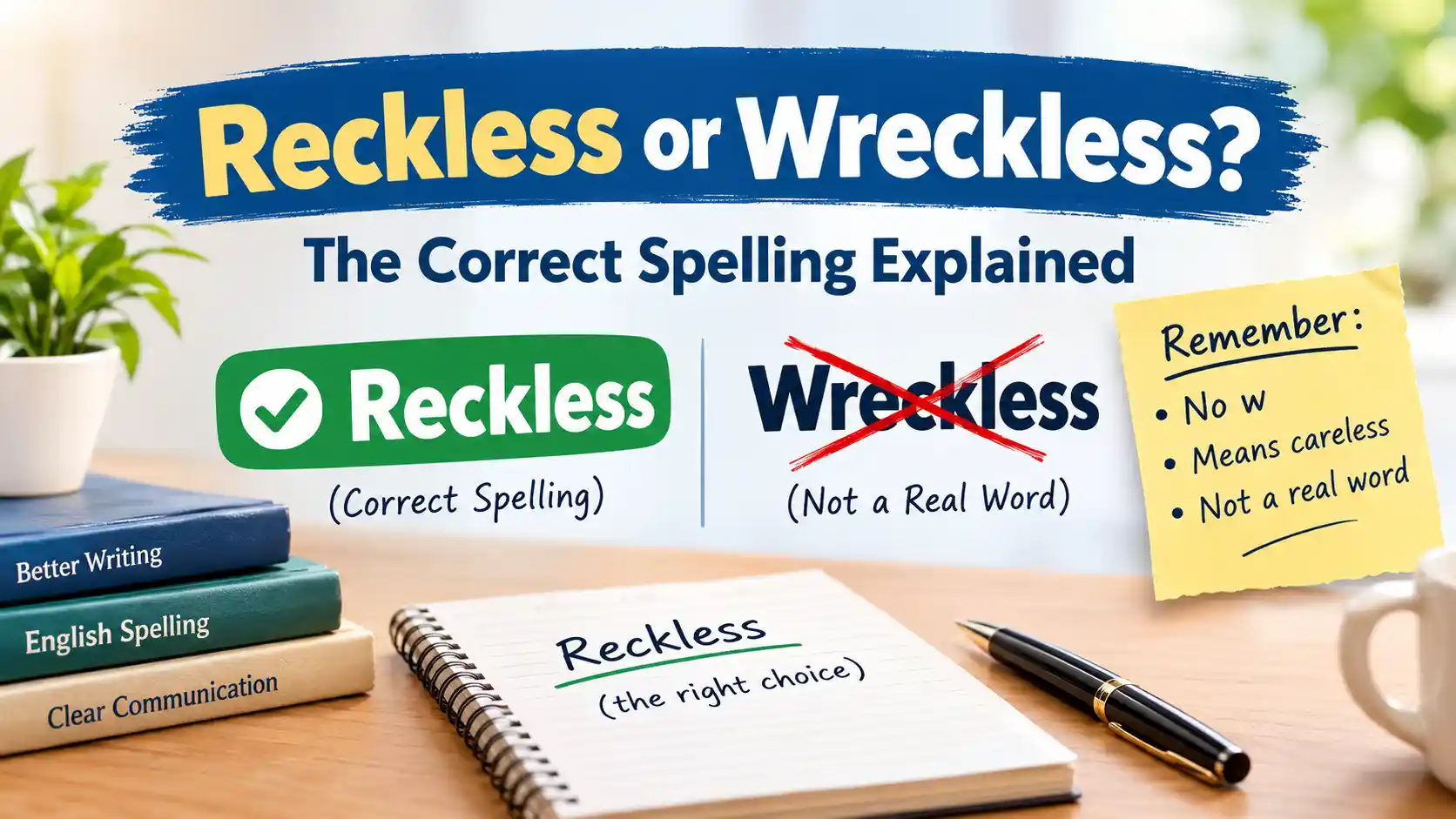
Reckless is the correct spelling. Wreckless is a misspelling.
Reckless means careless. It describes a person who does not think about danger or results.
Examples:
- He was fined for reckless driving.
- It was a reckless decision to quit without a plan.
- She made reckless promises she could not keep.
Wreckless does not appear in standard dictionaries. You may see it as a band name, a brand, or a joke. In normal writing, it is an error.
Easy memory trick: Reckless has no w. Say “Rec-less” and drop the w.
The Origin of “Reckless”
Reckless is very old. It comes from Old English. The root is reck, which means “to care” or “to pay attention.” Add -less (“without”), and you get “without care.”
So reckless literally means “not caring about the results.”
You rarely use reck alone today. It survives in a few old phrases, mostly in poems and old books. But recklessness stayed strong.
Now look at the wreck. It comes from an old word for something thrown up on the shore, like a ship’s broken parts. It is a different word with a different root.
So why do people mix them up?
- They sound alike. The w in the wreck is silent. Both words start with the “rek” sound.
- They feel linked in meaning. Reckless people often cause wrecks.
- English spelling is odd. Silent letters trick even native speakers.
The two words are cousins in sound, not in history.
British English vs American English Spelling
Many spelling fights come from British and American differences. Think colour and color, or center and centre.
This is not one of them. Both countries spell it reckless. There is no British version and no American version of “wreckless.”
| Word | US English | UK English | Correct? |
| Careless, without caution | reckless | reckless | Yes, everywhere |
| Misspelling | wreckless | wreckless | No, everywhere |
| Color | color | colour | Both, by region |
| Center | center | centre | Both, by region |
The difference between the two reckless spellings is simple. One is a real word and the other is a mistake. Region does not change that.
Which Spelling Should You Use?
Use reckless. Always.
- US readers: Use reckless.
- UK and Commonwealth readers: Use reckless.
- Global or mixed audiences: Use reckless.
- School, work, legal, or news writing: Use reckless.
Spellcheck will usually flag “wreckless.” Do not accept it as a style choice. Readers may think you made a typo, and that can hurt your credibility.
The only time “Wreckless” is fine is when it is a proper name, such as a band, a business, or a character. Then you copy the name exactly as written.
Common Mistakes with “Reckless”
1: Adding a w.
- Wrong: He is a reckless driver.
- Right: He is a reckless driver.
2: Mixing it up with “wreck.”
- Wrong: The reckless crash shocked everyone.
- Right: The reckless driver caused a wreck.
3: Spelling it “reckless.”
- Wrong: A reckless choice.
- Right: A reckless choice. Keep the k.
4: Using the wrong noun form.
- The noun is recklessness, not “wrecklessness.”
5: Thinking the w helps the meaning.
- It does not. Reckless means “careless.” It has nothing to do with wrecks in its spelling.
“Reckless” in Everyday Examples
Email:
“Please avoid reckless spending this quarter. We need to stay on budget.”
News:
“Police charged the man with reckless endangerment after the chase.”
Social media:
“Skipping sleep before an exam? That’s a reckless plan.”
Formal writing:
“The court found the company’s actions reckless and unsafe.”
Everyday talk:
“Don’t be reckless on those icy roads.”
Related words: careless, rash, hasty, irresponsible, daring.
“Reckless or Wreckless” Google Trends & Usage Data
I can’t pull live Google Trends numbers here, so I won’t invent figures. You can check them free at trends.google.com. Here is what the search pattern usually looks like:
- “Reckless” is searched far more often than “wreckless.” It is a common word in news and daily talk.
- “Wreckless” gets searches mostly from people checking the spelling. That is why queries like “reckless or wreckless” exist.
- English-speaking countries such as the US, UK, Canada, Australia, India, and Pakistan show interest, because spelling doubts happen in every region.
- Spikes often follow news about reckless driving, crimes, or public figures.
Tip: Compare the two words in Google Trends yourself. You will likely see “reckless” far above “wreckless.”
Keyword Variations Side by Side
| Variation | Real word? | Meaning | Use it? |
| reckless | Yes | Careless, ignoring danger | Yes |
| recklessly | Yes | In a careless way | Yes |
| recklessness | Yes | The state of being careless | Yes |
| wreckless | No | None (a misspelling) | No |
| wreck | Yes | A crash or ruin | Yes, for crashes |
| wrecked | Yes | Badly damaged or ruined | Yes, for damage |
FAQs
1. Is it reckless or wreckless?
It is reckless. “Wreckless” is a spelling mistake.
2. Is “wreckless” ever a real word?
Not in standard dictionaries. You might see it as a name for a band or brand.
3. Why do people write “wreckless”?
The word sounds like “wreck,” and reckless people often cause wrecks. The silent w adds to the mix-up.
4. What does “reckless” mean?
It means careless about danger or results, such as a reckless driver.
5. Is there a UK or US difference?
No. Both spell it reckless.
6. What is the noun form?
Recklessness. Not “wrecklessness.”
7. How can I remember the spelling?
Remember there is no w. A wreck is a crash, but reckless comes from reck, meaning “to care.” Reckless means “without care.”
Conclusion
The answer is simple. Reckless is correct, and wreckless is a mistake. This is true in the US, the UK, and everywhere else.
People mix them up for good reasons. The words sound alike, and a reckless act can lead to a wreck. But the two words have different roots. Reckless comes from an old word meaning “to care,” plus -less. So it means “without care.”
Here are the key points to remember:
- Write reckless, with no w.
- Use recklessly and recklessness for the other forms.
- Use wreck only when you mean a crash or ruin.
- Do not trust “wreckless,” even if you see it online.
- Use reckless in every setting: emails, school, news, and legal writing.
If you ever doubt it, say the word slowly: “reck-less.” Then drop the w. Clear, correct spelling helps readers trust your writing. Now you can write this word with confidence.

Sikandar Hayat is the author and creator of Journalneste.com, a website dedicated to heartfelt wishes, messages, greetings, and inspiring words for every special moment. With a passion for meaningful writing, Sikandar creates warm and thoughtful content that helps readers express their feelings with ease. His goal is to provide beautiful, shareable words for birthdays, celebrations, relationships, and memorable occasions.