You are typing an email. You stop. Has it occurred or occured? Your fingers freeze over the keys.
You are not alone. Many people search for this exact question every day. The word looks easy. It sounds easy. But the spelling trips up native speakers and learners alike.
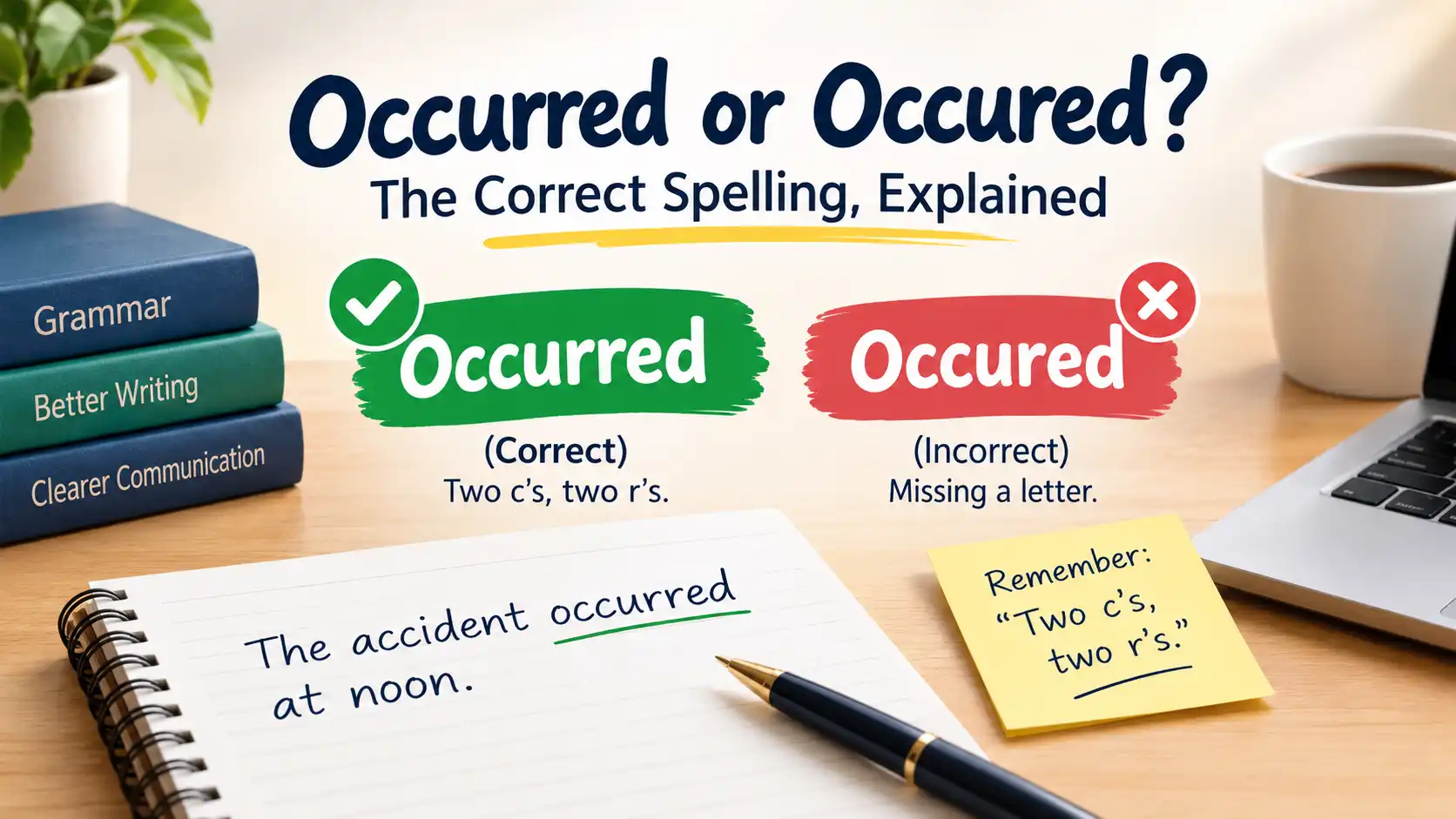
Here is the short answer. Occurred is correct. It has two c’s and two r’s. Occured has only one r. It is a spelling mistake.
So why do so many people get it wrong? Because the word breaks a common pattern. Most English words just add -ed to the end. Occur does not. It doubles the last letter first. The sound of the word does not show this. You can hear “uh-KURD,” but you cannot hear the extra r.
Spell check helps, but it does not always catch the error. Fast typing and phone screens make it worse.
This guide clears up the confusion. You will get a quick answer, the word’s history, and a US and UK comparison. You will also see real examples, common mistakes, and a simple FAQ. By the end, you will never doubt this word again.
Occurred or Occured Quick Answer
Occurred is the right spelling. Occured is wrong.
Occurred is the past tense of the verb occur. It means “happened.” Use it any time something takes place.
- The accident occurred at noon.
- The problem occurred after the update.
- A strange thing occurred last night.
Here is the simple rule. When a word ends in consonant-vowel-consonant, and the last syllable is stressed, double the last letter before -ed or -ing. Oc-CUR ends in c-u-r. The stress is on the last part. So the r doubles.
- occur → occurred
- occur → occurring
- occur → occurrence
Tip: remember “two c’s, two r’s.”
The Origin of Occurred or Occured
The word comes from Latin. The Latin verb occurrere means “to run toward” or “to meet.” It joins two parts: ob (toward) and currere (to run). English borrowed the word around the 1500s. At first it meant “to meet” or “to come to mind.” Over time it came to mean “to happen.”
That old Latin root explains the double c. The b in ob changed to match the c that followed. So ob + currere became occurrere. The same thing happened in words like occupy and occasion.
The double r came later. English has a spelling rule for short verbs with the stress on the last syllable. They double the final letter when you add -ed or -ing. Compare stop → stopped and refer → referred. Occur follows the same rule.
Why is it confusing?
- English spelling does not match its sound.
- You cannot hear the double r in “uh-KURD.”
- Many -ed words do not double the letter, such as visit → visited.
- Rare spellings stick in the mind less than common ones.
So the mistake is not about British or American style. It is just a tricky word.
British English vs American English Spelling
Good news: for this word, British and American English agree. Both spell it occurred. Neither accepts occurred.
The two styles do differ on a related rule. When a verb ends in a single consonant after a vowel:
- American English doubles the last letter only if the last syllable is stressed.
- British English often doubles it either way, especially with the letter l.
Occur is stressed on the last syllable (oc-CUR). So both styles double the r. Here is how it works across similar words.
| Base word | American spelling | British spelling | Why |
| occur | occurred | occurred | Stress on the last syllable. Both double. |
| refer | referred | referred | Stress on the last syllable. Both double. |
| prefer | preferred | preferred | Stress on the last syllable. Both double. |
| control | controlled | controlled | Stress on the last syllable. Both double. |
| travel | traveled | travelled | Stress on the first syllable. The US keeps one l. |
| cancel | canceled | cancelled | Stress on the first syllable. The US often keeps one l. |
| label | labeled | labelled | Stress on the first syllable. The US keeps one l. |
The lesson is simple. If you see travelled in a British text, it is not a typo. If you see occurred anywhere, it is.
Which Spelling Should You Use?
Use occurred. Always. There is no region where occured is correct.
Here is advice by audience:
- US readers: Use occurred. Pair it with American spellings elsewhere, such as color and traveled.
- UK, Australia, Canada, India and other Commonwealth readers: Use occurred. Pair it with colour and travel.
- Global or mixed readers: Use occurred. Pick one style for the rest of the text and stay with it.
- Students and exam takers: Use occurred. Teachers mark the single-r spelling as an error.
- Business and web writers: Use occurred. A typo in a proposal, resume or web page can hurt trust.
Only the other words in your text need a US or UK choice. This word does not.
Common Mistakes with Occurred or Occured
The single-r error is the big one. But this word family has other traps too.
| Wrong | Right | What went wrong |
| occured | occurred | Missing the second r |
| ocurred | occurred | Missing the first c |
| occurence | occurrence | Only one r |
| occurrance | occurrence | Ends in -ance, not -ence |
| occuring | occurring | Missing the second r |
| occurd | occurred | Missing the e |
A few more mix-ups:
- Occurred vs. happened. Both work, but occurred sounds more formal. “The meeting happened” is fine in chat. “The incident occurred” fits a report.
- Occurred vs. occurred to. “It occurred to me” means “I thought of it.” It is not about an event.
- Trusting spell check. It may miss the error in names, hashtags, or code comments.
A trick to remember: two c’s, two r’s. Say it out loud as you type. Then read the word once more before you hit send.
Occurred or Occured in Everyday Examples
See how the correct spelling looks in real life.
In an email
Hi Sam, an error occurred while I was uploading the file. I will try again after lunch.
In a news headline
Power outage occurred across the city on Tuesday night.
On social media
Something weird occurred at the gym today. Nobody believes me. 😂
In formal writing
The breach occurred on March 3. The company reported it within 24 hours, as the law requires.
In a school essay
The Industrial Revolution occurred first in Britain, then spread to other countries.
In a work report
No further issues have occurred since the fix. We will keep watching the system.
Notice the pattern. In every case, the word means “happened” and has two r’s.
Occurred or Occured Google Trends & Usage Data
Note: I could not pull live Google Trends numbers while writing this. The points below describe the usual pattern for spelling searches. Check Google Trends for exact, current figures before you publish.
What the data usually shows
- People search for the correct spelling far more than they type the wrong one in published text. Edited writing almost always occurs.
- Searches like “occurred or occured” are steady all year. They tend to rise during school and exam seasons, when more people write essays and reports.
- Spelling queries often do well in countries where English is a second or official language, such as India, Pakistan, Nigeria and the Philippines. Learners check words more often.
- The US, UK, Canada and Australia also search for it, mostly from people writing emails, reports and resumes.
Where the confusion happens
- Work: emails, reports, incident logs.
- School: essays and assignments.
- Phones: autocorrect and fast typing.
How to check it yourself
- Open Google Trends.
- Compare “occurred” and “occured.”
- Filter by country and by past 5 years.
- Look at “Related queries” for ideas, such as “occurrence spelling.”
Books and news tell the same story. Large text collections, such as Google Books Ngram, occurred far ahead of.
Occurred or Occured Spelling Variations Side by Side
| Spelling | Correct? | Part of speech | Example |
| occur | Yes | Verb (present) | Accidents can occur anywhere. |
| occurred | Yes | Verb (past) | The accident occurred at noon. |
| occurring | Yes | Verb (-ing form) | Errors keep occurring. |
| occurrence | Yes | Noun | It was a rare occurrence. |
| occured | No | None | Misspelling of occurred |
| occuring | No | None | Misspelling of occurring |
| occurence | No | None | Misspelling of occurrence |
| occurrance | No | None | Misspelling of occurrence |
FAQs
1. Has it occurred or occurred?
It occurred, with two c’s and two r’s. Occurred is a misspelling.
2. Is occured ever correct in British English?
No. British and American English use occurred.
3. Why does it have a double r?
The verb occur ends in a stressed consonant-vowel-consonant pattern. English doubles the last letter before -ed or -ing. Compare stop → stopped.
4. How do you spell the noun form?
The noun is an occurrence. It has two c’s and two r’s, and ends in -ence, not -ance.
5. What does occurred mean?
It means “happened” or “took place.” It can also mean “came to mind,” as in “It occurred to me.”
6. How can I remember the spelling?
Think “two c’s, two r’s.” You can also picture two pairs of letters sitting side by side in the middle of the word.
7. Did the same thing happen?
The meaning is close. Occurred is more formal and fits reports, news and business writing. Happened fits casual speech.
8. Will spell check catch occur?
Usually, yes. But it can miss the error in hashtags, names, code or text typed in apps with no spell check. Always proofread.
Conclusion
The debate is over. When you ask yourself, “occurred or occured?”, the answer is occurred. It has two c’s and two r’s. It works in American English, British English, and every other form of English.
Here are the key points to keep:
- Occurred is the past tense of occur. It means “happened.”
- Occured is always wrong. No region accepts it.
- The double r comes from a simple rule. Stressed consonant-vowel-consonant verbs double the last letter before -ed and -ing.
- The related words follow the same pattern: occurring and occurrence.
- US and UK spelling differences matter for words like traveled and travelled, but not for this word.
The word comes from the Latin occurrere, “to run toward.” That history explains the double c. The double r comes from English spelling habits.
My best advice is easy. Say “two c’s, two r’s” as you type. Read the word once more before you send. And do not rely only on spell check.
Now you can write this word with confidence in emails, essays, reports and posts.

Sikandar Hayat is the author and creator of Journalneste.com, a website dedicated to heartfelt wishes, messages, greetings, and inspiring words for every special moment. With a passion for meaningful writing, Sikandar creates warm and thoughtful content that helps readers express their feelings with ease. His goal is to provide beautiful, shareable words for birthdays, celebrations, relationships, and memorable occasions.