Have you ever stopped mid-sentence and asked, “Is it centre or center?” You are not alone. Millions of people type this question into Google every year. The word looks simple. Yet two spellings are both in daily use, and both are right.
People search for centre or center for good reasons. They are writing an email, a school essay, a website, or a job application. And they want to look sharp. They do not want to look careless. Some work with clients in the US. Others write for readers in the UK, India, Pakistan, or Australia. One wrong letter order can feel like a big mistake.
This guide clears up the confusion. You will learn the quick answer, where the word came from, and why the spellings split. And you will see side-by-side tables, real examples, and common errors. You will also learn which spelling fits your reader.
The short version is simple. The spelling depends on where your reader lives. Read on, and you will never second-guess it again.
Centre or Center Quick Answer
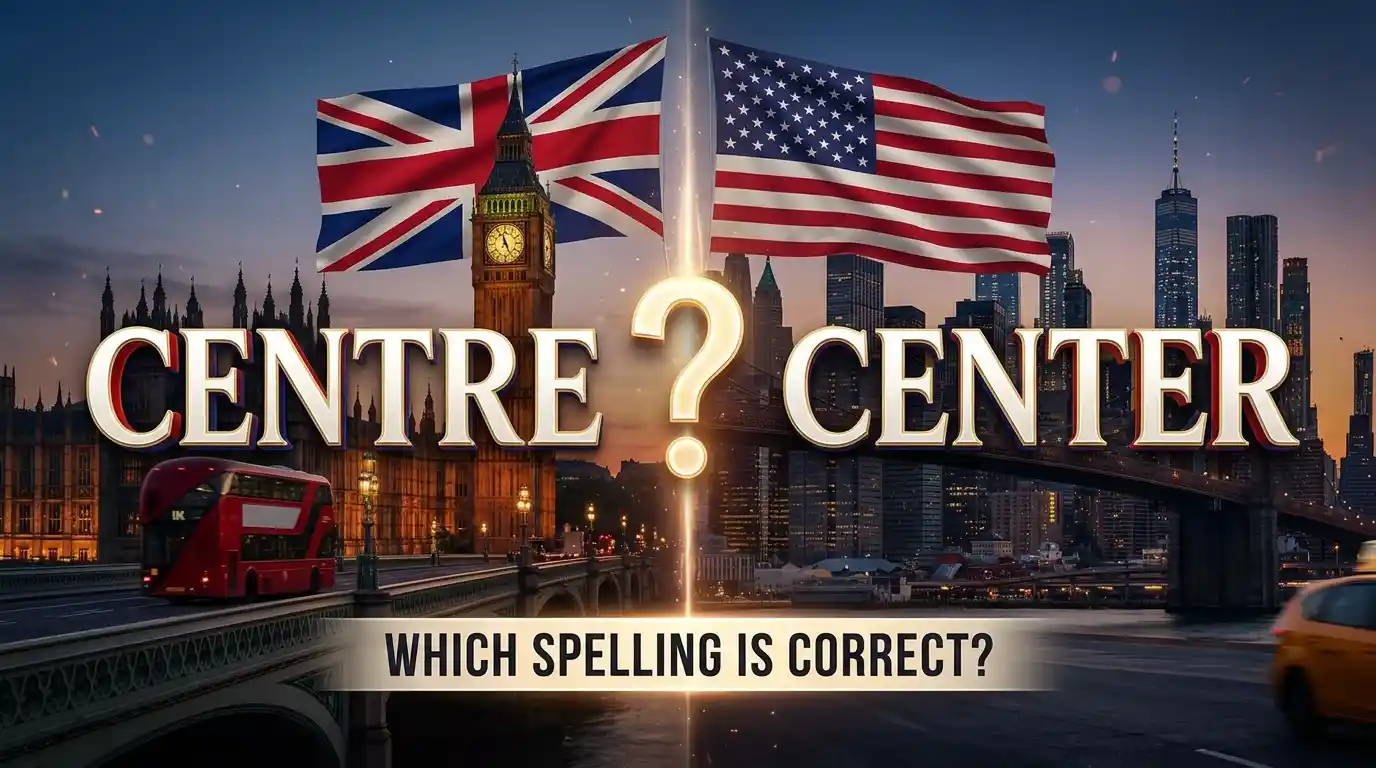
Both are correct. The center is American English. The centre is British English.
Use the center if your reader is in the United States. Use the centre if your reader is in the UK, Pakistan, India, Australia, New Zealand, Canada, or most other English-speaking countries.
Here are quick examples:
- US: The shopping center opens at nine.
- UK: The shopping centre opens at nine.
- US: She stood in the center of the room.
- UK: She stood in the centre of the room.
The meaning is the same. Only the spelling changes. Pick one style and keep it the same across your whole text.
The Origin of Centre or Center
The word is very old. It comes from the Greek word kentron, which meant a sharp point. Ancient Greeks used it for the point of a compass. The Romans borrowed it as centrum. Old French turned it into centre. English took the word from French in the Middle Ages.
So the -re ending is the older, French-style spelling. For many years, English writers used both forms. Spelling was not fixed back then.
The split came later. In the early 1800s, an American writer named Noah Webster wanted simpler spelling. His 1828 dictionary favored -er endings. He argued that center matched how people say the word. It was shorter and easier to learn.
America followed Webster. Britain did not. British writers kept the French-style -re. Over time, each side held its own habit. That is why the two spellings exist today.
British English vs American English Spelling
The rule is easy. Many words that end in -re in British English end in -er in American English. The sound stays the same. The last two letters swap places.
| Word type | British English | American English |
| Middle point | centre | center |
| Film house | theatre | theater |
| Distance unit | metre | meter |
| Unit of volume | litre | liter |
| Fibre in food | fibre | fiber |
| Not much | meagre | meager |
| Look or style | manoeuvre | maneuver |
There are a few exceptions. Some words keep -re in the US, such as acre and massacre. Also, meters in the US can mean a measuring device, while the British use metre only for length.
The rule also reaches related words. The British write centred, centring, and central. Americans write centered and centering. The word central is the same in both.
Which Spelling Should You Use?
The best spelling is the one your reader expects. Think about who will read your words.
- US audience: Use center. This fits American websites, ads, and business writing.
- UK audience: Use centre. This fits British news, schools, and companies.
- Commonwealth audience: Use centre. This covers Pakistan, India, Australia, New Zealand, South Africa, and most of Africa and South Asia. Canada mostly uses centre too.
- Global audience: Pick one style and stay with it. Many global brands choose American English. Others choose British English. Both work.
A few more tips:
- Set your spell checker to the right language. Choose English (US) or English (UK).
- Follow the style guide of your school, employer, or client.
- Keep proper names as written. A place called Centre Court or Center Parcs keeps its own spelling.
Consistency matters more than the choice. Mixing both spellings in one text looks careless.
Common Mistakes with Centre or Center
| Mistake | Why it is wrong | Fix |
| Mixing both in one text | Looks careless and uneven | Pick one style and keep it |
| “Centre” on a US website | US readers expect center | Use center |
| “Center” in a UK school essay | Markers expect British spelling | Use centre |
| “Centre of” and “centered” together | One is British, one is American | Use centre and centred |
| Writing “cneter” or “centar” | Letters in the wrong order | Check the spelling before sending |
| Changing a proper name | Names keep their own spelling | Copy the name exactly |
| Trusting a wrong spell-checker setting | The tool may flag a correct word | Set it to US or UK English |
The biggest error is mixing styles. Neither spelling is wrong. Switching between them in one document is the real problem.
Centre or Center in Everyday Examples
Here is how the word looks in real life.
Emails
- US: “Please meet me at the community center at 3 p.m.”
- UK: “Please meet me at the community centre at 3 p.m.”
News headlines
- US: “City opens new health center downtown”
- UK: “Council opens new health centre in town”
Social media
- US: “Best coffee in the center of town!”
- UK: “Best coffee in the centre of town!”
Formal writing
- US: “The research center published its annual report.”
- UK: “The research centre published its annual report.”
The word also works in common phrases. People say centre of attention in the UK and center of attention in the US. Sports fans say centre-back in British football and center in American basketball. In math, we say the center of a circle in the US and the centre of a circle in the UK.
Centre or Center Google Trends & Usage Data
Note: These are general patterns, not exact figures. For live numbers, check Google Trends and compare “centre” with “center” for your country.
Worldwide, the center is searched far more than the center. The reason is size. The US has a huge online audience, and American spelling shows up in business names, software, and product pages.
The picture changes by country:
- United States: Center leads by a wide margin.
- United Kingdom: Centre leads in everyday use, such as “leisure centre” and “town centre.”
- Australia, New Zealand, Ireland: Centre leads in everyday writing.
- Canada: Mixed. Centre is common in formal and public writing, while center appears in tech and American brands.
- India and Pakistan: Mixed. British spelling is taught in schools, but center is common in business names, such as “call center” and “training center.”
Context matters too. People searching for a phrase like “center for disease control” are usually looking for a US organization, so those searches use center. People searching for “shopping centers near me” in the UK use centers.
In short, search interest follows the reader’s location and the topic. It does not show that one spelling is more correct.
Centre vs Center: Side-by-Side Comparison
| Form | British English | American English |
| Noun | centre | center |
| Plural | centres | centers |
| Verb (past) | centred | centered |
| Verb (-ing) | centring | centering |
| Adjective | central | central |
| Place name | town centre | town center |
| Common phrase | centre of attention | center of attention |
| Compound | centre-back | center-back |
| Where used | UK, Pakistan, India, Australia, NZ | United States |
FAQs About Centre or Center
1. Is it centre or center? Both are correct. Center is American. Centre is British.
2. Which spelling is used in Pakistan and India? British English is the school standard, so centre is the formal choice. You will still see center in many business names.
3. Is “center” a mistake in the UK? It is not a typo, but it looks American. UK readers and markers expect centre.
4. How do you spell the past tense? British: centred. American: centered.
5. Does “central” change between the two? No. Central is spelled the same in both styles.
6. Can I use both spellings in one document? No. Pick one style and keep it. Mixing them looks careless.
7. Which spelling is better for SEO? Use the spelling your readers search for. Match your audience’s country, and use the same spelling across your site.
8. Do company names follow the rule? No. Names keep their own spelling, such as Centre Court or Center Parcs. Copy them exactly.
Conclusion
The question of centre or center has a simple answer. Both spellings are correct. They belong to different styles of English.
Here are the key points to remember:
- Center is American English.
- Centre is British English, used in the UK, Pakistan, India, Australia, New Zealand, and many other places.
- The word comes from the Greek kentron, through Latin and French. Noah Webster pushed the -er form in America.
- The same rule works for theatre/theater and metre/meter.
- Mixing both spellings in one text is the real mistake.
My advice is easy. First, know your reader. Second, choose the spelling that fits them. Third, set your spell checker to match. Finally, stay consistent from the first line to the last.
For American readers, write center. And for British or Commonwealth audiences, choose centre. For a global audience, select one spelling and use it consistently.. Your readers will notice the care you took, and your writing will look clean, sharp, and professional.

Sikandar Hayat is the author and creator of Journalneste.com, a website dedicated to heartfelt wishes, messages, greetings, and inspiring words for every special moment. With a passion for meaningful writing, Sikandar creates warm and thoughtful content that helps readers express their feelings with ease. His goal is to provide beautiful, shareable words for birthdays, celebrations, relationships, and memorable occasions.