You are typing fast. You reach for a word. Is it site or cite? Many people search for “site or cite” every month. The two words sound the same, and they look almost the same. But they mean very different things. One is about a place. The other is about giving credit.
Mix them up, and your writing looks careless. A school paper can lose points. A work email can look sloppy.
People search this keyword for one reason: they want a fast, clear answer. Some also want to know why English has such tricky words. Others wonder if the spelling changes between the US and the UK.
This article clears it all up. You get the quick answer first. Then you learn where each word comes from, see real examples and common mistakes, and pick up a simple trick to remember the difference.
Site or Cite Quick Answer
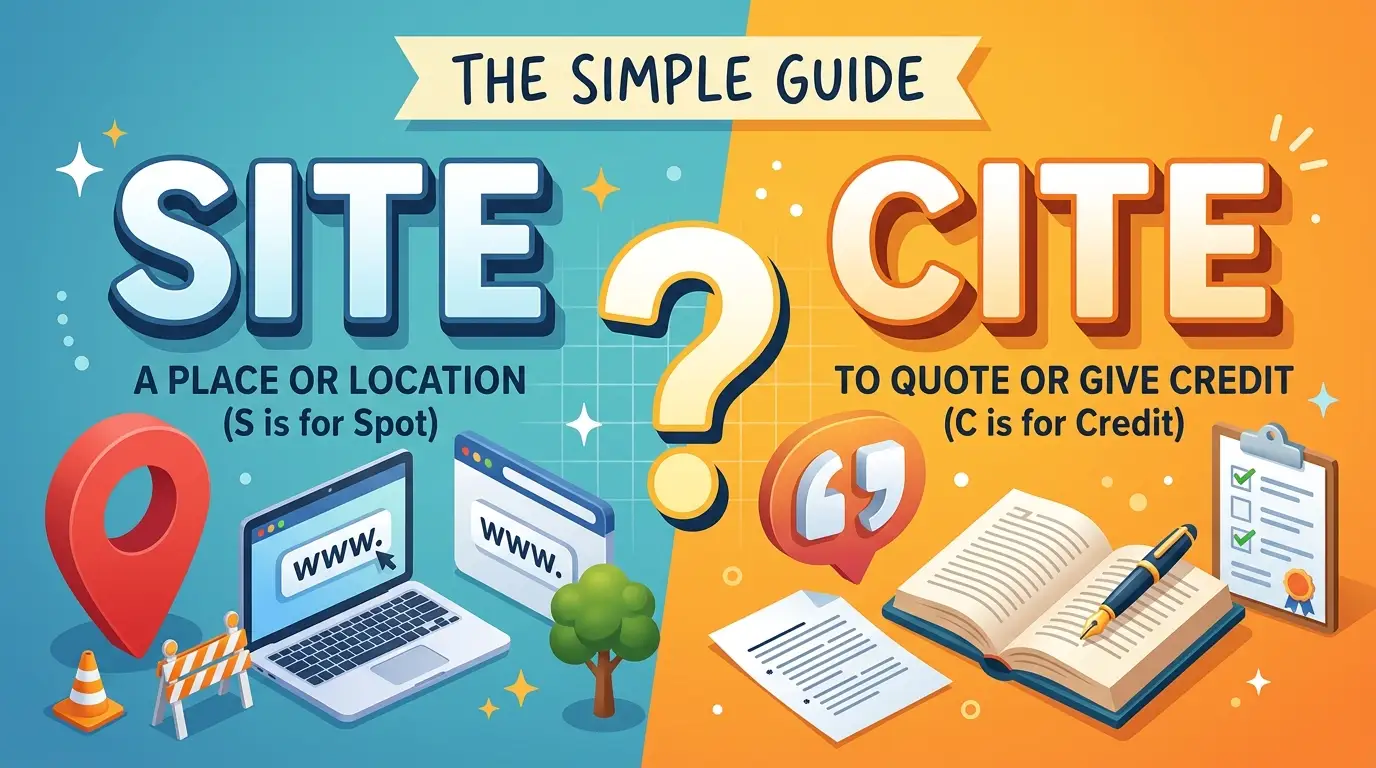
Site means a place or a location. Cite means to mention something as proof, or to give credit to a source.
- Use site for a place: The workers left the building site.
- Use site for the internet: I found the answer on a news site.
- Use cite for credit: Please cite your sources.
- Use cite for proof: The judge will cite an old law.
Memory trick: Site has an s, like spot. Cite starts with c, like credit.
The Origin of Site and Cite
The two words come from different roots, and that is why they mean different things.
Site comes from the Latin word situs. It means “place” or “position.” It passed through Old French into English around the 1300s. Today it also means a place online, as in website.
Cite comes from the Latin word citare. It means “to call” or “to summon.” It also passed through Old French. In the 1400s, people used it to mean “call to court.” Later it grew to mean “call up a source as proof.”
So why do they sound the same? Over hundreds of years, English changed how it says words. The “s” and “c” sounds became the same before an “i.” The result is a pair of homophones. Homophones are words that sound alike but have different spellings and meanings.
A third word joins the mix: sight. It comes from Old English and means the ability to see. It sounds the same too, which makes the confusion worse.
British English vs American English Spelling
Here is the good news. There is no spelling difference between British and American English for these words. Both countries spell them the same way. Many other words do change, like color and colour. But site and cite do not.
The confusion is not about country. It is about meaning.
| Word | Meaning | US spelling | UK spelling | Example |
| site | a place or web page | site | site | The site is closed today. |
| cite | to quote or give credit | cite | cite | Cite the book in your essay. |
| sight | the ability to see | sight | sight | The sight of the sea was lovely. |
| sited | placed in a location | sited | sited | The school was sited near a river. |
| cited | quoted or named as proof | cited | cited | She cited three studies. |
Same spelling on both sides of the Atlantic. You only need to choose the right word.
Which Spelling Should You Use?
Since the spelling does not change by country, the choice depends on meaning, not on your audience. Still, here is how it plays out for different readers.
- US readers: Students often cite sources in school papers. Style guides like APA and MLA teach this.
- UK and Commonwealth readers: Same rule. You cite sources in essays, and you talk about a building site or a web site.
- Global readers: Use the same rules. Clear writing matters more when readers speak English as a second language.
One small note: in the UK, people write website as one word, and so do most people in the US. Both are fine.
Quick rule: Ask yourself, “Am I talking about a place?” If yes, write site. “Am I giving credit or proof?” If yes, write cite.
Common Mistakes with Site or Cite
Here are errors people make often, with fixes.
- Wrong: Please site your sources.
Right: Please cite your sources. - Wrong: The construction cite is very busy.
Right: The construction site is very busy. - Wrong: I will cite you on that website.
Right: I will cite you, and I will link to your site. (Different meanings, so check each one.) - Wrong: It was a beautiful cite.
Right: It was a beautiful sight. - Wrong: She sited a famous poem.
Right: She cited a famous poem. - Wrong: Cite visit: in a link or label.
Right: Site visit.
Spell-check will often miss these. Every one of them is a real word, so the software sees nothing wrong. Read your work once more before you hit send.
Site or Cite in Everyday Examples
- “Please visit our site to see the new prices.”
- “Please cite the report in your summary.”
News
- “Police closed off the crash site.”
- “The mayor cited new data to explain the change.”
Social media
- “New blog post is live on my site!”
- “Always cite the artist when you share art.”
Formal and school writing
- “The writer must cite every source in the bibliography.”
- “The team chose a site for the new lab.”
Legal writing
- “The lawyer will cite a past case.”
- “The accident site was photographed.”
Site or Cite Google Trends and Usage Data
I can’t pull live Google Trends numbers here, so I won’t give you exact figures. Here is what is generally true about how people use these words, and how you can check it yourself.
- “Site” is far more common. People use it all day for websites, as in “site map,” “site search,” and “job site.”
- “Cite” is less common. It spikes during school terms, when students write papers and look up how to cite sources.
- “Site or cite” as a question search shows up in places with many students and many English learners. Searches rise at exam times and during essay season.
- Countries where English is widely used in school, such as the US, the UK, India, Pakistan, Canada, and Australia, see steady interest.
To see real numbers, go to Google Trends. Type “site or cite” and compare it with “cite or sight.” Then filter by country and time. You can also add “cite sources” to see the school-season pattern.
Keyword Variations Side by Side
| Keyword | Meaning | Common use | Mistake risk |
| site | place or web page | construction site, news site | Often used for “cite” by mistake |
| cite | to quote or credit | cite a source | Often written as “site” |
| sight | seeing | a sight to see | Mixed up with both |
| website | page(s) on the internet | company website | Rare, but “web cite” is wrong |
| cite sources | give credit | school papers | “Site sources” is wrong |
| building site | place of work | job planning | “Building cite” is wrong |
FAQs
1. What is the difference between site and cite?
Site is a place, on land or online. Cite means to quote a source or give proof.
2. Is it “cite your sources” or “site your sources”?
It is cite your sources. You are giving credit, so use cite.
3. Is “site” spelled differently in British and American English?
No. Both use site. The same goes for cite.
4. How do I remember which is which?
Site is a spot, and both start with s. Cite is for credit, and both start with c.
5. Is a website a “web site” or a “website”?
Today, website as one word is standard in both US and UK writing.
6. What does “sight” mean, and how is it different?
Sight means the power to see, or something you see. It has nothing to do with places or sources.
7. Can spell-check catch these mistakes?
Not always. All three are real words, so many tools miss the error. Check by meaning, not just spelling.
8. Are “cite” and “quote” the same?
Close, but not the same. To quote is to repeat words. To cite is to point to where they came from.
Conclusion
Here is what to remember about “site or cite.”
Site means a place. It can be a building site, a camp site, or a website. Cite means to name a source, quote, or proof. Sight means seeing. All three sound the same, but each has its own job.
There is no US versus UK spelling fight here. Everyone spells these words the same. The only choice is meaning. Ask one simple question: “Is this a place, or is this credit?” Place means site. Credit means cite.
Watch for the common slips. “Site your sources” is wrong. “Cite visit” is wrong. “A beautiful cite” is wrong. These errors look small, but readers notice them, and they can hurt your grade or your image at work.
Spell-check will not save you, because each word is real. Take ten extra seconds to reread your work. Use the memory tricks: s for spot, c for credit.
With these rules, you can write with confidence in emails, essays, posts, and reports.

Sikandar Hayat is the author and creator of Journalneste.com, a website dedicated to heartfelt wishes, messages, greetings, and inspiring words for every special moment. With a passion for meaningful writing, Sikandar creates warm and thoughtful content that helps readers express their feelings with ease. His goal is to provide beautiful, shareable words for birthdays, celebrations, relationships, and memorable occasions.