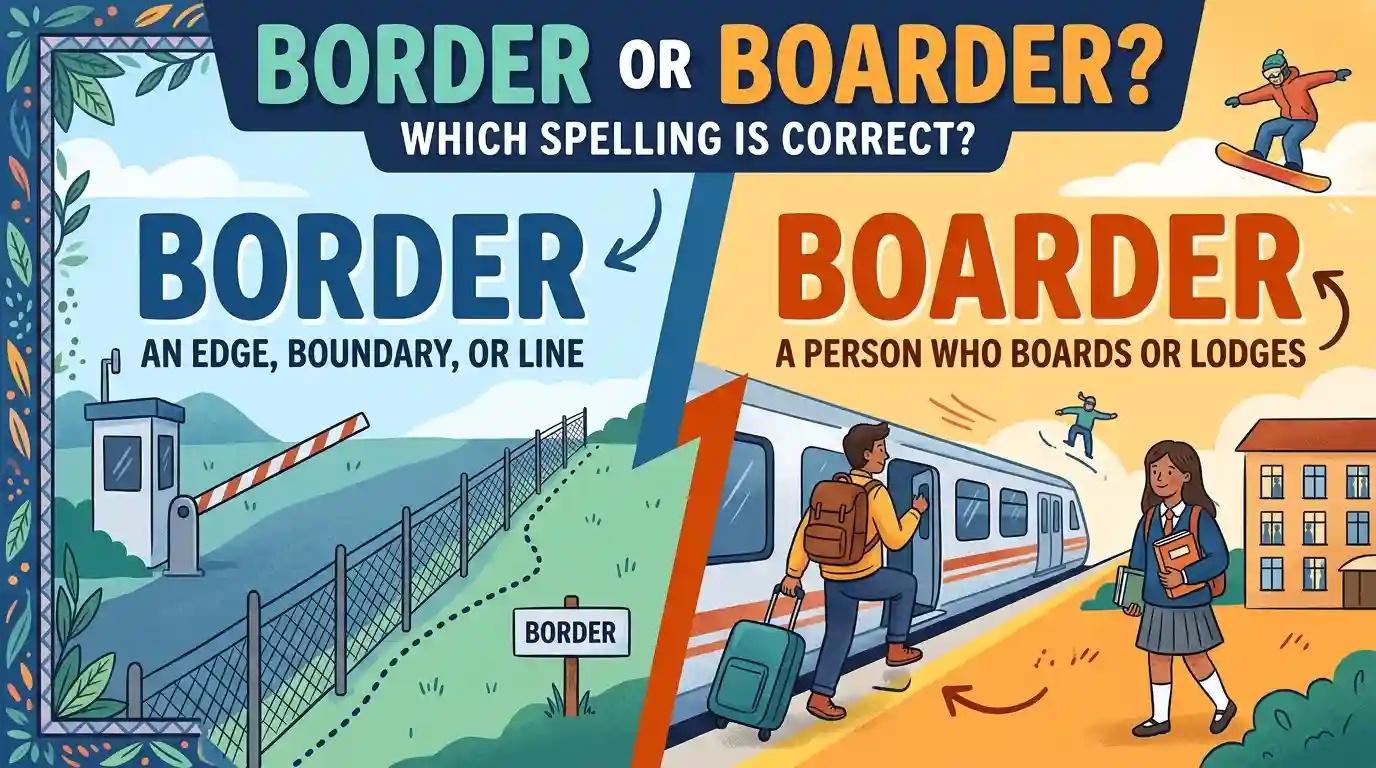
You are typing fast. You write “border,” then stop. Should it be “boarder”? The two words look alike. They sound the same. One extra letter can change your whole sentence.
Many people hit this problem. Students, writers, and office workers all search “border or boarder” to check. Some think it is a British versus American spelling issue. It is not. These are two different words with two different meanings.
This guide clears up the confusion fast. You get the quick answer first. Then you learn where each word came from. You see how British and American spelling really differ. You also get tips for emails, news, and school work.
Here is the short version. A border is a line or an edge. A boarder is a person who pays to stay somewhere, or a person who gets on a plane, train, or ship. Read on for examples, common mistakes, a comparison table, and answers to the questions people ask most.
Border or Boarder Quick Answer
Both spellings are correct. They are different words. Pick the one that fits your meaning.
Border means an edge or a dividing line.
- The border between Canada and the United States is long.
- She added a blue border to the page.
- The garden has a border of red flowers.
- Our land borders the river. (Here it is a verb: to touch or sit next to.)
Boarder means a person who boards.
- The school has fifty boarders. (Students who live at school.)
- The family took in a boarder to help pay rent. (A paying guest.)
- Every boarder found a seat on the train. (A person getting on.)
Easy memory trick: A boarder boards. Look for the word “board” inside it. A border has “order” inside it. Think of rules and guards at the edge of a country.
The Origin of Border and Boarder
Both words grew from old Germanic roots. Many dictionaries link them to a word for a board, a plank, or a side. That is why they look so close today.
Where “border” came from. English took it from Old French bordure. That word came from bord, meaning edge or side. By the Middle Ages, English speakers used it for the edge of a cloth, a field, or a land.
Where “boarder” came from. It grows from the English word board. A board was a plank. It was also a table. People ate at a table, so “board” came to mean meals. That gave us the phrase “room and board.” A person who paid for both was a boarder. Sailors also spoke of going “on board” a ship, so boarding grew to mean getting on a vessel, and later a plane or train.
Why the spellings differ. English spelling was loose for hundreds of years. Writers spelled words as they heard them. The “-er” ending in boarder simply means “a person who does this.” The “-der” in border came from the French. The two words ended up with almost the same sound but different spellings and different jobs.
British English vs American English Spelling
Here is the key fact. Border and boarder are spelled the same in British and American English. The split between the two is about meaning, not about country.
People often guess otherwise because British and American English do differ on many other words. Compare the pairs below.
| Word | British English | American English | Same in both? |
| Edge or line | border | border | Yes |
| Person who boards | boarder | boarder | Yes |
| Color | colour | color | No |
| Center | centre | center | No |
| Organize | organise (or organize) | organize | Partly |
| Traveling | travelling | traveling | No |
| Grey | grey | gray | No |
The typical rules are simple. British English often uses “-our” (colour), “-re” (centre), and a double “l” (travelling). American English often uses “-or,” “-er,” and one “l.” Neither rule touches border or boarder.
One more note. Both words sound alike in most accents of English, in the UK and the US. They are homophones. So you cannot fix the spelling by listening. You must think about the meaning.
Which Spelling Should You Use?
Use the spelling that matches your meaning. Your audience does not change the answer.
- US readers: Use border for an edge or line. Use boarder for a lodger, a boarding-school student, or a person getting on a vehicle.
- UK and Commonwealth readers: The same rule applies. You will also see boarder used a lot for students at boarding schools, and in South Asia for students who live in a hostel.
- Global readers: Keep it plain. Border for edges and lines. Boarder for people who board.
Quick test. Ask one question: “Is this a line, or is this a person?”
- A line or edge: border
- A person who boards or lodges: boarder
A word on other spellings. If your audience is American, write “color” and “center.” If it is British, write “colour” and “centre.” Pick one style and keep it through the whole piece. For border and boarder, you never have to choose a side.
Common Mistakes with Border or Boarder
These errors show up often. Each has a quick fix.
| Mistake | Fix | Why |
| Boarder control at the airport | Border control | It is about the edge of a country. |
| We crossed the boarder at dawn. | We crossed the border at dawn. | A crossing happens at a line. |
| The border took the 6 p.m. flight. | The boarder took the 6 p.m. flight. | A person gets on a flight. |
| Boarderline case | Borderline case | Borderline is one word built on border. |
| A bordering school for girls | A boarding school for girls | Boarding means students live there. |
| The school has 40 borders. | The school has 40 boarders. | Boarders are students who live at school. |
| Add a boarder to the table. | Add a border to the table. | A table or page edge is a border. |
Why people slip. The words sound the same. Spell-check will not catch it, because both are real words. The fix is to read the sentence once more and ask: line or person?
Border or Boarder in Everyday Examples
In an email
- “Please add a thin border around the chart before you send it.”
- “We have one boarder in the spare room until June.”
In the news
- “Officials closed the border after the storm.”
- “The boarder was safe after the ferry hit the dock.”
On social media
- “Stuck at the border for three hours. Send snacks!”
- “My sister is a boarder at school and misses home cooking.”
1:In formal writing
- “The two nations share a border of 3,000 kilometres.”
- “Each boarder must follow the house rules listed in the handbook.”
2:In design and crafts
- “Use a flower border to frame the invitation.”
3:In sports
- “Every boarder, on snow or on skate, must wear a helmet.”
Notice the pattern. Every border is an edge or a line. Every boarder is a person.
Border or Boarder Google Trends & Usage Data
These notes describe general patterns. They are not exact figures. For live numbers, check Google Trends and compare “border” with “boarder” for your country and date range.
Border is far more common. In nearly every country, people search and write “border” much more than “boarder.” Border is a core word in news, travel, law, and design. Boarder is a smaller, niche word.
Interest in border rises with news. Searches for “border” usually jump when a story is about travel rules, trade, or migration. They also rise around holidays and school breaks, when people cross borders.
Boarder is tied to school and housing. In the UK, India, Pakistan, and other places with many boarding schools and hostels, “boarder” appears more often in school and rental contexts. It also appears in sports talk about snowboarders and skateboarders.
The search “border or boarder” is a spelling check. People type it when they are unsure. It tends to peak in school terms, when students write essays, and when workers write reports and emails.
Side-by-side comparison of word forms
| Word | Part of speech | Meaning | Typical context | Example |
| border | noun | Edge or dividing line | News, travel, design, law | The border is closed. |
| border | verb | To touch or lie next to | Geography, gardens | Fields border the road. |
| bordering | adjective | Next to | Geography | Bordering countries |
| borderline | adjective or noun | Close to a limit | Everyday talk, medicine, sports | A borderline pass |
| boarder | noun | Person who lodges or boards | School, housing, travel | The school has 40 boarders. |
| boarding | noun or adjective | Getting on, or living at school | Travel, school | Boarding pass, boarding school |
| boarded | verb | Got on, or lodged | Travel, housing | We boarded the train. |
FAQs
1. Is it “border” or “boarder”? Both are right. “Border” is an edge or line. “Boarder” is a person who boards or lodges.
2. Is “boarder” a British spelling of “border”? No. They are two separate words. Both are spelled the same in British and American English.
3. Do border and boarder sound the same? In most accents, yes. They are homophones. That is why people mix them up in writing.
4. What is a border guard? A border guard is an officer who watches a country’s edge. The correct spelling uses “border,” not “boarder.”
5. What is a boarder at school? A boarder is a student who lives at school during term. Students who go home each day are called day students.
6. Is “borderline” spelled with an “a”? No. It is “borderline,” one word, built on “border.”
7. Can “border” be a verb? Yes. “Spain borders France” means the two touch. The forms are border, borders, bordered, and bordering.
8. How can I remember the difference? A boarder boards. Look for “board” inside the word. A border is a line. Think of order at the edge.
Conclusion
The answer to “border or boarder” is simple. Both are correct. They just mean different things.
A border is an edge or a line. It can divide two countries, frame a page, or run along a garden. As a verb, it means to touch or sit next to something.
A boarder is a person. It can be a paying guest, a student who lives at school, or someone getting on a plane, train, or ship.
This is not a British versus American issue. Both words are spelled the same in the UK, the US, and everywhere else. The real differences between those two styles show up in words like colour and color.
Here is your usage advice. Ask one question each time: is it a line, or is it a person? Line means border. Person means boarder. Use the memory trick too. A boarder boards. A border keeps order at the edge.
Before you send an email, post, or report, scan for these two words. Spell-check cannot catch the mistake, because both are real. A quick second look will keep your writing sharp and professional.

Sikandar Hayat is the author and creator of Journalneste.com, a website dedicated to heartfelt wishes, messages, greetings, and inspiring words for every special moment. With a passion for meaningful writing, Sikandar creates warm and thoughtful content that helps readers express their feelings with ease. His goal is to provide beautiful, shareable words for birthdays, celebrations, relationships, and memorable occasions.