Have you ever stopped mid-sentence and wondered: is it loath or loathe? You are not alone. Many people type this question into Google. The two words look almost the same. They sound almost the same. But they do not mean the same thing.
People search for “loath or loathe” for one simple reason. They want to write the right word, and they want to do it fast. Maybe it is an email to your boss. It is possible an essay due tonight. Maybe you just read a sentence that looked wrong. One small letter, the final “e,” changes everything.
This article clears up the confusion. You will get a quick answer first. Then you will learn where the words came from. You will see if British and American writers spell them differently. You will also find common mistakes, real examples, and answers to common questions.
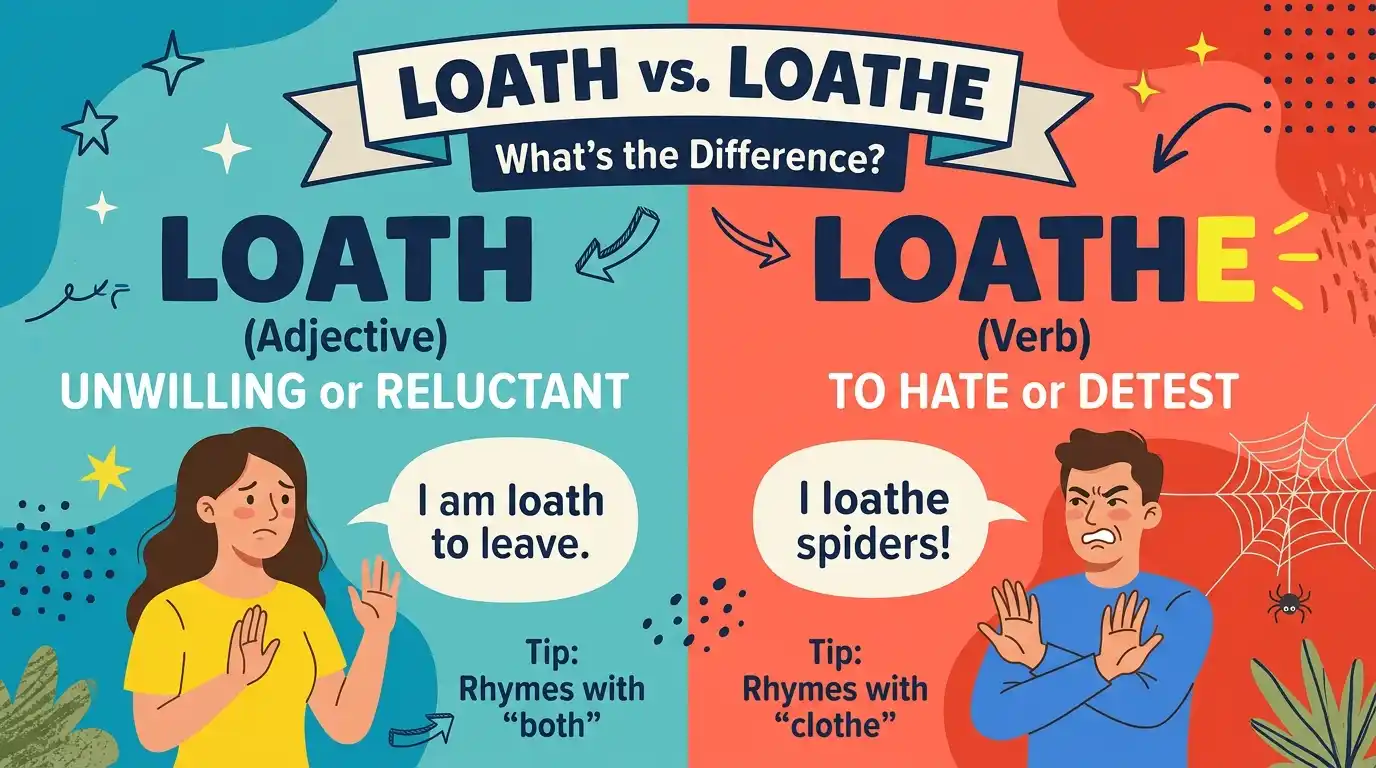
Here is the short version. Loath is an adjective. It means unwilling. Loathe is a verb. It means to hate. Read on, and you will never mix them up again.
Loath or Loathe Quick Answer
Loath (rhymes with “both”) is an adjective. It means unwilling or reluctant.
- I am loath to leave the party early.
- She was loath to admit she was wrong.
Loathe (rhymes with “clothe”) is a verb. It means to hate something very much.
- I loathe waking up at 5 a.m.
- He loathes cold coffee.
Here is an easy trick. The word loathe has an “e” at the end, just like hate. Both are action words. No “e” means no action. Loath only describes how you feel.
The Origin of Loath and Loathe
Both words come from the same old root. In Old English, the word lāð meant hateful, hostile, or harmful. It is also related to words in other old Germanic languages that carried the idea of harm or sorrow.
Over time, English split that one root into two forms:
- The adjective stayed short: loath.
- The verb grew an “e”: loathe.
The extra “e” is not random. English often uses a final “e” to show a soft, voiced “th” sound (as in “this”). Look at these pairs:
| Noun or adjective (hard th) | Verb (soft th) |
| breath | breathe |
| cloth | clothe |
| bath | bathe |
| loath | loathe |
So the spelling differences are about sound and job, not about country. You may also see an old spelling, loth. It is rare today, and most modern writers use loath.
The meaning of loath also softened over the years. It once meant “hateful.” Today it means “unwilling.” The verb loathe kept the stronger sense of deep hatred.
British English vs American English Spelling
Here is the good news. There is no British or American split for this pair. Both countries use loath and loathe the same way. The difference is meaning, not region.
Many people think it is like color and colour. It is not. With color and colour, one meaning has two spellings. With loath and loathe, two meanings have two spellings.
| Feature | Loath | Loathe |
| Part of speech | Adjective | Verb |
| Meaning | Unwilling, reluctant | To hate, to detest |
| Sound | Rhymes with “both” | Rhymes with “clothe” |
| American spelling | loath | loathe |
| British spelling | loath | loathe |
| Related words | loath to (do something) | loathed, loathing, loathsome |
| Example | I am loath to complain. | I loathe long queues. |
Notice that the American and British rows match. Neither side changes a letter.
Some real US and UK differences do exist in other words. Examples are color/colour and organize/organise. But loath and loathe are not on that list.
Which Spelling Should You Use?
The answer depends on what you mean, not where you live.
- US readers: Use loath for “unwilling” and loathe for “hate.”
- UK and Commonwealth readers: Use the same rule. Britain, Canada, Australia, India, and Pakistan all follow it.
- Global or business readers: Use the same rule. If your reader may be unsure, pick a simpler word. “Unwilling” and “hate” are always safe.
A quick test works every time. Ask yourself: Is this an action?
- If you can swap in “hate,” write loathe.
- If you can swap in “unwilling,” write loath.
If you write for a wide audience, plain words can be a good choice. But for style and punch, both words are fine when spelled right.
Common Mistakes with Loath or Loathe
| Mistake | Fix | Why |
| I loath spiders. | I loathe spiders. | “Hate” is a verb. It needs the “e.” |
| I am loathe to go. | I am loath to go. | “Unwilling” is an adjective. No “e.” |
| She loathes to admit it. | She is loath to admit it. | “Loath to” describes a feeling. It is not an action. |
| He was loathing the idea. (meaning unwilling) | He was loath to try the idea. | “Loathing” means deep hatred. It is not “unwilling.” |
| a loathesome smell | a loathsome smell | The adjective drops the “e.” |
| I am loth to say. | I am loath to say. | “Loth” is an old spelling. Most readers expect “loath.” |
Two more tips:
- Check the sound. If you say “loath” with the soft “th” of “clothe,” you may be thinking of the verb.
- Watch the pattern “loath to.” It nearly always uses the adjective.
Loath or Loathe in Everyday Examples
- “I am loath to push the deadline again, but we need two more days.”
- “I loathe asking for help, but I am stuck on this report.”
News headlines and reports
- “Voters are loath to back the new tax.”
- “Fans loathe the new ticket rules.”
Social media
- “I loathe Monday meetings. Send coffee.”
- “Loath to admit it, but I cried at that movie.”
Formal writing
- “The committee was loath to change the policy without more evidence.”
- “The author appears to loathe the character he created.”
In each line, check the job. Is it a feeling (unwilling)? Use loath. Is it an action (hating)? Use loathe.
Loath or Loathe Google Trends & Usage Data
I did not pull live Google Trends numbers for this article, so I will not invent any. Here is what is generally true, and how to check it yourself.
General patterns
- Loathe is used far more often than loath in everyday writing. People use it to say “hate” with strong feeling.
- Loath shows up mostly in formal, literary, and news writing, often in the phrase “loath to.”
- The search “loath or loathe” comes mostly from English-speaking countries, such as the US, UK, Canada, Australia, India, Pakistan, and Ireland.
- Interest tends to rise when people write: students during term time, and professionals drafting emails and reports.
How to check the data yourself
- Go to Google Trends.
- Enter “loath,” “loathe,” and “loath or loathe” as compared terms.
- Set the country, then the time range.
- Open the “Related queries” box to see what people ask next.
Keyword variations side by side
| Form | Type | Meaning | Example |
| loath | Adjective | Unwilling | I am loath to quit. |
| loathe | Verb | To hate | I loathe traffic. |
| loathes | Verb (he/she/it) | Hates | She loathes spiders. |
| loathed | Verb (past) | Hated | They loathed the rain. |
| loathing | Noun or verb form | Deep hatred | He felt loathing for the lie. |
| loathsome | Adjective | Hateful, disgusting | A loathsome habit. |
| loth | Adjective (old spelling) | Unwilling | Rare. Use “loath.” |
FAQs About Loath or Loathe
1. Is it loath or loathe?
It depends on the job. Use loath when you mean “unwilling.” Use loathe when you mean “hate.”
2. Is “I am loathe to go” correct?
No. The right form is “I am loath to go.” The phrase needs the adjective, which has no “e.”
3. How do you say loath and loathe?
Loathe has a soft “th,” like “clothe.” Loath is most often said with a hard “th,” like “both.” Some speakers use the soft sound for both, so trust the spelling, not the sound.
4. Do Americans and Brits spell them differently?
No. Both use loath for the adjective and loathe for the verb.
5. Is “loth” a real word?
Yes, but it is an old spelling of loath. Today it is rare. Use loath in modern writing.
6. What does “nothing loath” mean?
It is an old phrase that means “quite willing.” The writer says the person was not unwilling at all. It sounds formal, so use it with care.
7. What is the noun for loathe?
The noun is loathing. It means strong hatred or disgust. The adjective loathsome describes something that deserves that feeling.
Conclusion
The gap between loath and loathe is small on the page, but big in meaning. Loath is an adjective. It means unwilling. Loathe is a verb. It means to hate. The final “e” tells your reader which one you mean.
Remember three things. First, this is not a US versus UK issue. Both use the same spelling. Second, sound can help. Loath usually rhymes with “both.” Loathe rhymes with “clothe.” Third, use the swap test. If “hate” fits, write loathe. If “unwilling” fits, write loath.
Avoid the common slips. Do not write “I loath spiders.” Do not write “I am loathe to go.” Watch for loathsome, which has no “e,” and loathing, which drops the “e” before “-ing.”
When in doubt, pick a plainer word. “Hate” and “unwilling” work in any email, essay, or post. But with these tools, you can now use loath and loathe with confidence.

Sikandar Hayat is the author and creator of Journalneste.com, a website dedicated to heartfelt wishes, messages, greetings, and inspiring words for every special moment. With a passion for meaningful writing, Sikandar creates warm and thoughtful content that helps readers express their feelings with ease. His goal is to provide beautiful, shareable words for birthdays, celebrations, relationships, and memorable occasions.