You are at the store. You see a bright orange tub in the freezer. Is it sherbert or sherbet?
You are not alone. Many people ask this question online. Many people say the word with two Rs. Then they write it with two Rs too. Then they stop and wonder if that is wrong.
That is why this keyword is so popular. The word sounds one way, but it is spelled another way. Then add the US and UK meanings, and it gets messier. In the US, sherbet is a frozen fruit treat. In the UK, it is often a fizzy sweet powder.
This guide clears it all up. You will get the quick answer first. Then you will learn where the word came from. This guide shows how US and UK spelling compare. It explains which one to use and which mistakes to avoid. Real examples, a comparison table, and a short FAQ are included as well.
Read on, and you will never doubt this word again.
Sherbert or Sherbet Quick Answer
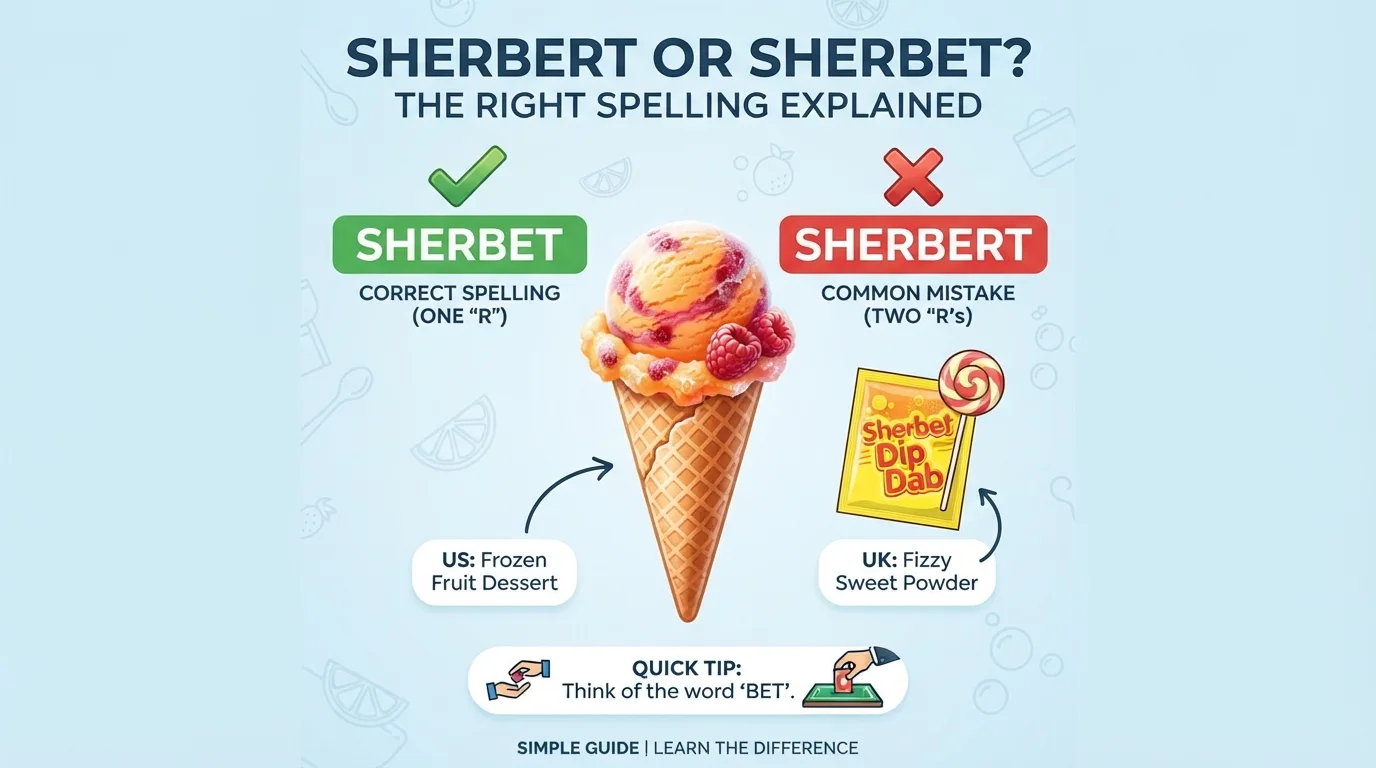
Sherbet is the correct spelling. It has one R in the middle: S-H-E-R-B-E-T.
Sherbert is a common mistake. It comes from the way many people say the word. They add an extra “r” sound near the end. Some dictionaries list it as a rare variant. But style guides, teachers, and editors all prefer sherbet.
Here are two quick examples:
- ✅ “I want orange sherbet for dessert.”
- ❌ “I want orange sherbert for dessert.”
If you only remember one thing, remember this: write sherbet, even if you say sherbert.
The Origin of Sherbet
The word is old. It is much older than the ice cream aisle.
It began in the Middle East. The Arabic word sharba means “a drink.” It comes from a root that means “to drink.” Persian had a similar word, sharbat. Turkish had şerbet. All of them meant a sweet, cool fruit drink.
Travelers brought the word to Europe. English borrowed it in the early 1600s. At first, sherbet meant a sweet drink from the East. It was often made with fruit juice, sugar, and snow or ice.
Over time, the meaning changed:
- In the US, it became a frozen dessert made with fruit and a little milk.
- In the UK and some other countries, it became a fizzy sweet powder, often sold in paper tubes or as “sherbet dips.”
Sherbet and sorbet are cousins. They come from the same old roots. Sorbet came through French and Italian. Sherbet came more directly into English.
Why does the extra R show up?
Say the word out loud: “SHER-bit.” Many people say “SHER-bert.” The extra “r” sound slips in because it feels easy to say. It is a pronunciation habit. Then people spell the word the way they say it. That is how the wrong spelling spread.
Words change in speech all the time. But spelling is slower to change. So sherbet stays the standard spelling.
British English vs American English Spelling
Here is a surprise. This is not a typical UK vs US spelling fight.
Think of “color” and “colour.” One is American. One is British. Both are right in their own place.
Sherbet is different. Both the US and the UK spell it “sherbet.” The version with two Rs is a mistake in both places.
What differs is the meaning, not the spelling.
| Feature | American English | British English |
| Standard spelling | sherbet | sherbet |
| Common mistake | sherbert | sherbert |
| Main meaning | Frozen fruit dessert | Fizzy sweet powder |
| Typical example | Orange sherbet in a cone | Sherbet dip dab from a sweet shop |
| Dairy content | A small amount of milk | Usually none |
| Close cousin | Sorbet (no dairy) | Sorbet (no dairy) |
A quick note on the US meaning: in the US, sherbet is a real food category. It has less milk fat than ice cream. It has more than sorbet, which has none.
Which Spelling Should You Use?
The answer is easy: sherbet. But the right advice depends on who is reading.
If your readers are in the US
Use sherbet. It is the standard. You will see it on food labels, in menus, and in news stories.
If your readers are in the UK or the Commonwealth
Use sherbet. It is standard there too. Just remember the word often means the fizzy powder, not the frozen dessert. If you mean the frozen treat, you can add the word “ice” or say “sorbet” to be clear.
If your readers are all over the world
Use sherbet. Add a short clue so no one is confused. For example: “orange sherbet (a frozen fruit dessert).”
If you are writing for work, school, or a website
Use sherbet. A wrong spelling can make a page look careless. It can also hurt trust.
What about SEO?
People do search for “sherbert.” If you want to catch those searches, you can use the word once, as a question. For example: “Is it sherbert or sherbet?” Then answer it. Use sherbet everywhere else.
Common Mistakes with Sherbert or Sherbet
Here are the errors people make most often, with easy fixes.
| Mistake | Fix | Why |
| sherbert | sherbet | The extra R is a speech habit, not part of the spelling |
| sherbit | sherbet | The last vowel is “e,” not “i” |
| sherbat | sherbet | This looks like the Arabic root but is not the English spelling |
| sorbet = sherbet | They are different foods | Sorbet has no dairy. US sherbet has a little |
| “Sherbet” as only a dessert | Check your audience | In the UK, it often means a fizzy powder |
| Sherbert’s | Sherbet’s | Keep the same spelling when you add an apostrophe |
| sherberts | sherbets | The plural is simply “sherbets” |
A simple memory trick
Think of the word “bet.” You can bet that sherbet ends in a bet. One R. No extra “ert.”
Sherbert or Sherbet in Everyday Examples
Here is how the right spelling looks in real life.
In an email
Hi Sam, For the party, I will bring orange sherbet and some cookies. See you Saturday!
In a news story
The shop sold out of lime sherbet during the heatwave, the owner said.
On social media
Rainbow sherbet on a hot day = perfect. 🍧 #sherbet #summer
In a formal menu or report
Dessert: Raspberry sherbet with fresh mint.
In a UK sweet-shop context
She bought a tube of sherbet and two fruit chews.
As a question (good for SEO and teaching)
Is it sherbert or sherbet? The correct spelling is sherbet.
Notice that the right spelling fits every setting, from a casual post to a formal menu.
Sherbert or Sherbet Google Trends & Usage Data
Note: the points below describe general patterns. For exact, current numbers, check Google Trends yourself at trends.google.com. Results change over time.
Here is what you can expect to see.
Both spellings get searched. People search for “sherbet” because they want the food or the sweet. People search for “sherbert” because they are unsure how to spell it, or they spell it the way they say it.
Searches often rise in warm weather. Frozen dessert searches usually grow when the weather heats up. So interest in this question tends to follow the seasons in each country.
Country matters.
- In the US, searches lean toward the frozen dessert, flavors, and brands.
- In the UK, Australia, and New Zealand, searches lean toward the fizzy powder and old-style sweets.
- In many countries, a lot of searches are simply spelling checks.
Context matters. Food and recipe pages use “sherbet.” Spelling and grammar pages often use “sherbert or sherbet” as a question.
How to check it yourself
- Go to Google Trends.
- Type in “sherbet” and “sherbert.”
- Change the country, then the date range.
- Look at “Related queries” to see what people want to know.
Side-by-side comparison
| Variation | Correct? | Typical use | Who uses it |
| sherbet | ✅ Yes | Food labels, menus, news, books | US, UK, and worldwide |
| sherbert | ❌ No (rare variant at best) | Spoken habit, typos, spelling searches | Many casual writers |
| sorbet | ✅ Yes, but a different food | Dairy-free frozen dessert | US, UK, and worldwide |
| sherbet dip / dip dab | ✅ Yes | Fizzy sweet powder with a lollipop or stick | Mostly UK and Commonwealth |
| sharbat | ✅ Yes, in other languages | Sweet fruit drink in South Asia and the Middle East | Urdu, Hindi, Persian, Arabic speakers |
FAQs About Sherbert or Sherbet
1. Is it sherbert or sherbet?
It is sherbet. The version with two Rs is a common mistake.
2. Why do so many people say “sherbert”?
The extra “r” sound is easy to say. People add it by habit. Then they spell it that way too.
3. Is “sherbert” ever correct?
Some dictionaries list it as a rare variant. But almost all editors, teachers, and style guides want sherbet. When in doubt, use sherbet.
4. Is sherbet the same as sorbet?
No. Sorbet has no dairy. US sherbet has a small amount of milk. They come from the same old root word, though.
5. Is sherbet the same as ice cream?
No. Ice cream has much more milk fat. Sherbet is lighter and fruitier.
6. What does sherbet mean in the UK?
It often means a fizzy, sweet powder. You eat it from a tube or with a dipstick. It can also mean the frozen dessert, but that use is less common.
7. Is the spelling different in the US and the UK?
No. Both use sherbet. The meaning is what changes, not the spelling.
8. Where does the word come from?
It comes from the Arabic sharba (a drink). Persian and Turkish had similar words. English borrowed it in the early 1600s.
9. What is the plural of sherbet?
The plural is sherbets.
Conclusion
So, is it sherbert or sherbet? The answer is clear. Sherbet is the right spelling. It has one R and ends in “bet.”
Here are the key points to take with you:
- Sherbert is a spoken habit. It is not the standard spelling.
- The word comes from Arabic, Persian, and Turkish words for a sweet drink.
- The US and the UK both spell it sherbet. Only the meaning is different.
- In the US, it means a frozen fruit dessert. In the UK, it often means a fizzy sweet powder.
- Sherbet and sorbet are not the same thing.
- Use the memory trick: sherbet ends in “bet.” One R, no extra “ert.”
Our advice is simple. Say it however you like. But when you write it, write sherbet. That works in emails, menus, news, school papers, and social posts. It also keeps your writing clean and trusted.
If your readers are global, add a few words to explain what you mean. That way, no one is confused.
Now you know the answer. Share it with the next person who asks.

Sikandar Hayat is the author and creator of Journalneste.com, a website dedicated to heartfelt wishes, messages, greetings, and inspiring words for every special moment. With a passion for meaningful writing, Sikandar creates warm and thoughtful content that helps readers express their feelings with ease. His goal is to provide beautiful, shareable words for birthdays, celebrations, relationships, and memorable occasions.