You cut your finger. Now you need to write about it. Do you write “my finger bleed” or “my finger bled”? Many people stop and wonder. You are not alone.
People search “bleed or bled” for one big reason. They want to know which word is right. The two words look close, and they sound close. But they are not the same. One is for now. One is for the past.
There is a second worry too. Some people think this is a British vs American spelling thing. Is it “colour” and “color” all over again? It is not. That is the confusion this guide clears up.
Here you will find a quick answer first. Then you will learn where the words come from. You will see tables, real examples, common mistakes, and answers to the questions people ask most.
By the end, you will know when to use bleed. You will know when to use bled. And you will never write “bleeded” again.
Let’s start with the fast answer.
Bleed or Bled Quick Answer
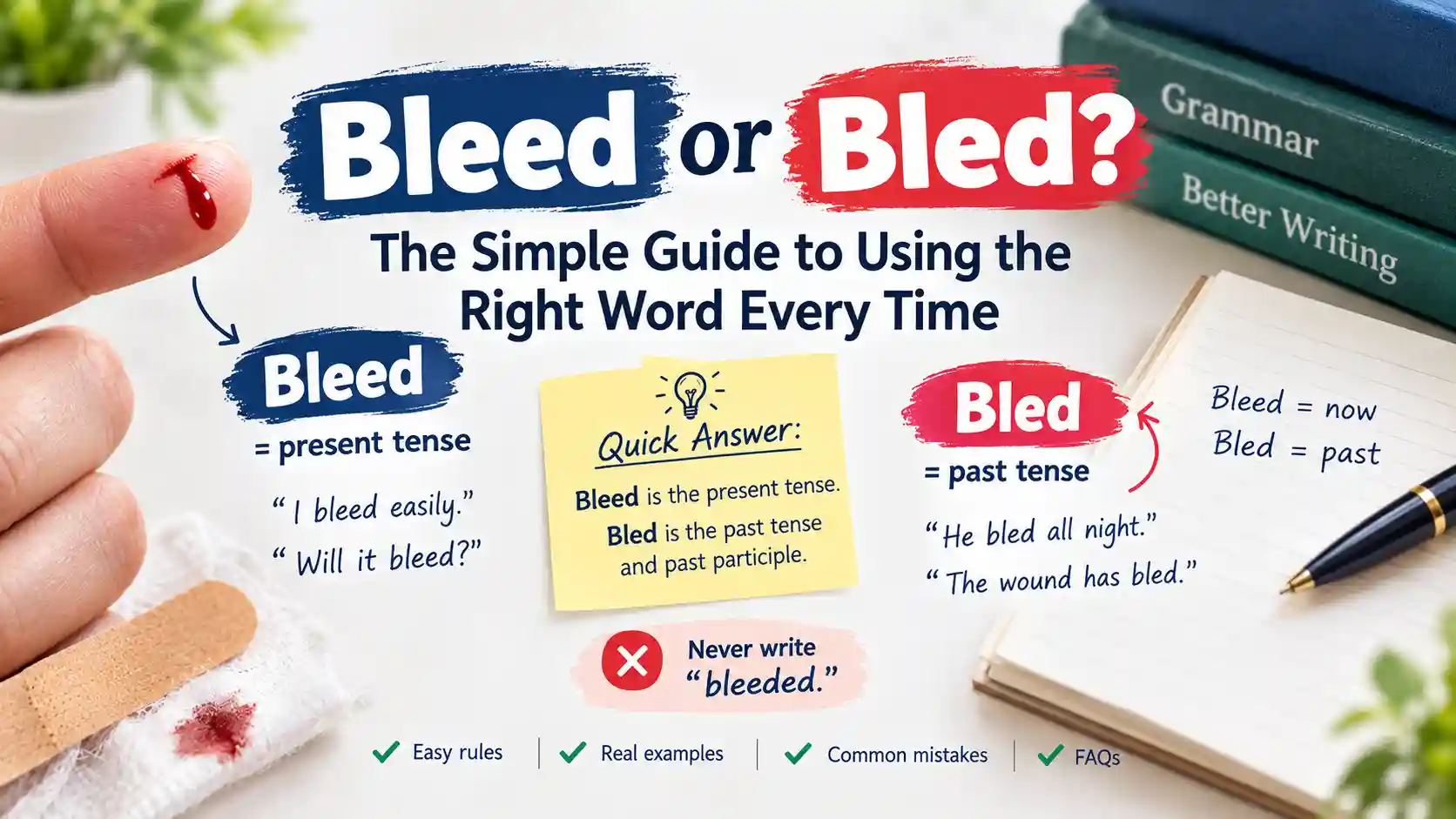
Bleed is the present tense. Bled is the past tense and the past participle.
That is the whole rule.
- Use bleed for now or the future: “I bleed easily.” “Will it bleed?”
- Use bled for the past: “He bled all night.” “The wound has bled.”
Examples:
- Present: Paper cuts bleed a lot.
- Past: My nose bled yesterday.
- Past participle: The cut had bled through the bandage.
- Future: This ink will bleed if it gets wet.
Never write “bleeded.” It is not a real word in standard English.
The Origin of Bleed and Bled
The word bleed is very old. It comes from Old English. In Old English, the word was blēdan. It grew from blōd, the word for blood. So the link is simple: to bleed is to lose blood.
Old English had many verbs that changed their vowel sounds in the past tense. Over time, the long “ee” sound in bleed got shorter in the past tense. That gave us bled.
This same thing happened to other words:
- feed → fed
- lead → led
- speed → sped
- breed → bred
- read → read (said “red”)
These are all short-vowel past tenses. Bled belongs to this family.
Why do people say “bleeded”?
Most English verbs just add -ed for the past: walk → walked. So the brain wants to do the same here. Children do this often. Adults slip too. But verbs like bleed are “irregular.” They follow older rules, not the -ed rule.
Why do spelling differences exist in English at all?
English took words from many languages. Printers set spellings in the 1400s and 1500s. Later, Noah Webster pushed for simpler spellings in the US in the early 1800s. That is why “color” is American and “colour” is British. But bleed and bled were not touched by this. Both countries use the same forms.
British English vs American English Spelling
Here is the good news. There is no British vs American difference for bleed and bled. Both words are spelled the same in every major English-speaking country.
The only difference people think they see is a tense difference, not a spelling difference.
| Form | American English | British English | Notes |
| Present tense | bleed | bleed | Same everywhere |
| Past tense | bled | bled | Same everywhere |
| Past participle | bled | bled | Same everywhere |
| -ing form | bleeding | bleeding | Same everywhere |
| Wrong form | bleeded | bleeded | Wrong in both |
Compare this with words that do change:
| Word | American | British |
| Color | color | colour |
| Center | center | centre |
| Learned (past) | learned | learnt (also learned) |
| Dreamed (past) | dreamed | dreamt (also dreamed) |
Notice that learned/learnt and dreamed/dreamt do vary. That may be why people expect bleed to vary too. It does not.
Which Spelling Should You Use?
The answer is easy. It depends on tense, not on where your reader lives.
If your audience is American: Use bleed for now and bleed for the past.
If your audience is British, Australian, Canadian, Indian, or Pakistani: Use bleed for now and bleed for the past. The same rule applies.
If your audience is global: Use the same rule. You are safe.
A simple test: Add the word “yesterday” to your sentence. If it fits, use bled. If it does not fit, use bleed.
- “Yesterday my knee ___.” → bled ✔
- “Every time I fall, my knee ___.” → bleeds ✔ (add -s for he/she/it)
Tip for formal writing: Pick a tense and stay with it. Do not jump between bleed and bleed in one paragraph unless the time really changes.
Common Mistakes with Bleed and Bled
1: Using “bleeded.”
- ❌ He bleeded a lot.
- ✅ He bled a lot.
2: Using “bleed” for the past.
- ❌ Yesterday my gums bleed.
- ✅ Yesterday my gums bled.
3: Using “bled” for now.
- ❌ My nose often bled in winter. (when you mean it still happens)
- ✅ My nose often bleeds in winter.
4: Forgetting the -s.
- ❌ A paper cut bleed easily.
- ✅ A paper cut bleeds easily.
5: Mixing up “bled” and “bleed” after “had” or “has.”
- ❌ The wound has bleed.
- ✅ The wound has bled.
6: Using “bleed” and “blead.” There is no word “blead.” Check your spelling.
Quick fix: After had, has, or have, use bled. After will, can, to, or might, use bleed.
Bleed and Bled in Everyday Examples
In an email:
- “The colors may bleed when you wash the shirt. Please use cold water.”
- “The print bled on the last batch. We need to redo the order.”
In the news:
- “The team blew points in the second half.”
- “The company is bleeding money.”
- “Doctors say the patient bled for hours before help came.”
On social media:
- “My heart bleeds for everyone affected.”
- “Bled for this win. Worth it.”
- “Why does this red sock always bleed in the wash?”
In formal writing:
- “The wound should be pressed to stop it from bleeding.”
- “The artist bled color across the canvas.”
- “Funds bled from the account over three months.”
The printing and design:
- A “bleed” is the extra space around a page. It lets ink run to the edge. For example: “Add a 3 mm bleed to the design.”
In idioms:
- Bleed dry to take all money from someone: “They bled him dry.”
- A bleeding heart is a very soft-hearted person.
- If it bleeds, it leads to a news story about dramatic stories.
- Bleed into when one thing spreads into another: “Work bled into my weekend.”
Bleed or Bled Google Trends & Usage Data
Note: Exact numbers change every day. For live data, open Google Trends and enter “bleed or bled.” The points below describe common patterns, not exact figures.
Who searches for this phrase? Interest tends to come from English-speaking countries and from places where English is a second language. These include the United States, the United Kingdom, Canada, Australia, India, Pakistan, Nigeria, and the Philippines.
Why do they search?
- Students and learners want to check grammar for homework or exams.
- Writers and bloggers want to fix tense in their work.
- Non-native speakers are often unsure about irregular verbs.
- Health readers look up the words when describing injuries or symptoms.
- Designers and printers search “bleed” for print settings, which can mix into results.
Usage patterns:
- “Bleed” is more common overall because it covers present tense, future tense, and the printing noun.
- “Bled” shows up more in stories, news reports, and health writing about past events.
- Searches for “bleeded” also exist. This shows many people are unsure of the rule.
Comparison table: keyword variations side by side
| Word | Tense / Type | Example | Correct? |
| bleed | Present | I bleed when I get cut. | ✅ |
| bleeds | Present (he/she/it) | She bleeds easily. | ✅ |
| bleeding | -ing form | He is bleeding. | ✅ |
| bled | Past | He bled last night. | ✅ |
| bled | Past participle | It has bled through. | ✅ |
| bleeded | — | He bleeded. | ❌ |
| blead | — | The cut blead. | ❌ |
| bleed (noun) | Printing term | Add a 3 mm bleed. | ✅ |
FAQs
1. Is it “bleed” or “bled”? Both are right. Bleed is for now. Bled is for the past.
2. Is “bleeded” a word? No. It is not correct in standard English. Use bled.
3. What is the past tense of bleed? The past tense is bled. The past participle is also bled.
4. Is “bled” British or American? Both. It is used the same way in the US, the UK, and everywhere else.
5. Is “bleed” ever used in the past? Not as a verb. But “bleed” can be a noun in printing. For example: “The design needs a bleed.”
6. How do I say “bleed” and “bled”? Bleed sounds like “bleed” with a long “ee” (like need). Bled sounds like “bled” with a short “e” (like red).
7. What is a “bleed” in printing? It is the extra area past the trim line. It stops thin white edges after cutting.
8. Which is correct: “My nose bleed” or “My nose bled”? Neither is right alone. For the past, say “My nose bled.” For a habit, say “My nose bleeds.”
9. What other verbs work like bleed? Feed → fed, lead → led, breed → bred, speed → speed. They all shortened the vowel in the past.
Conclusion
Let’s sum it up. The question “bleed or bled” has a simple answer.
Bleed is the present tense. Use it for things happening now or often. Bled is the past tense. Use it for things that already happened. It is also the past participle, so use it after has, have, and had.
There is no US vs UK spelling split here. Both forms are the same around the world. The only wrong form is “bleeded.” Skip it every time.
Remember the quick test. Add “yesterday” to your sentence. If it fits, write bled. If not, write bleed. And do not forget the -s for he, she, and it: “It bleeds.”
Bleed also has special uses. It is a printing term. It shows up in sayings like “bleeding heart” and “bleed dry.” In these cases, check the tense and the meaning.
Keep this guide close when you write emails, posts, reports, or school work. With a little practice, the right word will come fast. Clear writing builds trust. Now you can write about bleeding, bled ink, and bled points with full confidence.

Sikandar Hayat is the author and creator of Journalneste.com, a website dedicated to heartfelt wishes, messages, greetings, and inspiring words for every special moment. With a passion for meaningful writing, Sikandar creates warm and thoughtful content that helps readers express their feelings with ease. His goal is to provide beautiful, shareable words for birthdays, celebrations, relationships, and memorable occasions.