Struggling to pick between realest and realist? You’re not alone. Every day, thousands of writers, students, and social media users pause mid-sentence, unsure which word fits. These two words look almost the same. They sound almost the same when spoken fast. But they mean very different things.
This mix-up happens for a good reason. English has many word pairs that trip people up “affect” vs “effect,” “its” vs “it’s,” and now “realest” vs “realist.” People search for this term because they want a fast, clear answer before hitting “send” on an email, a post, or an assignment.
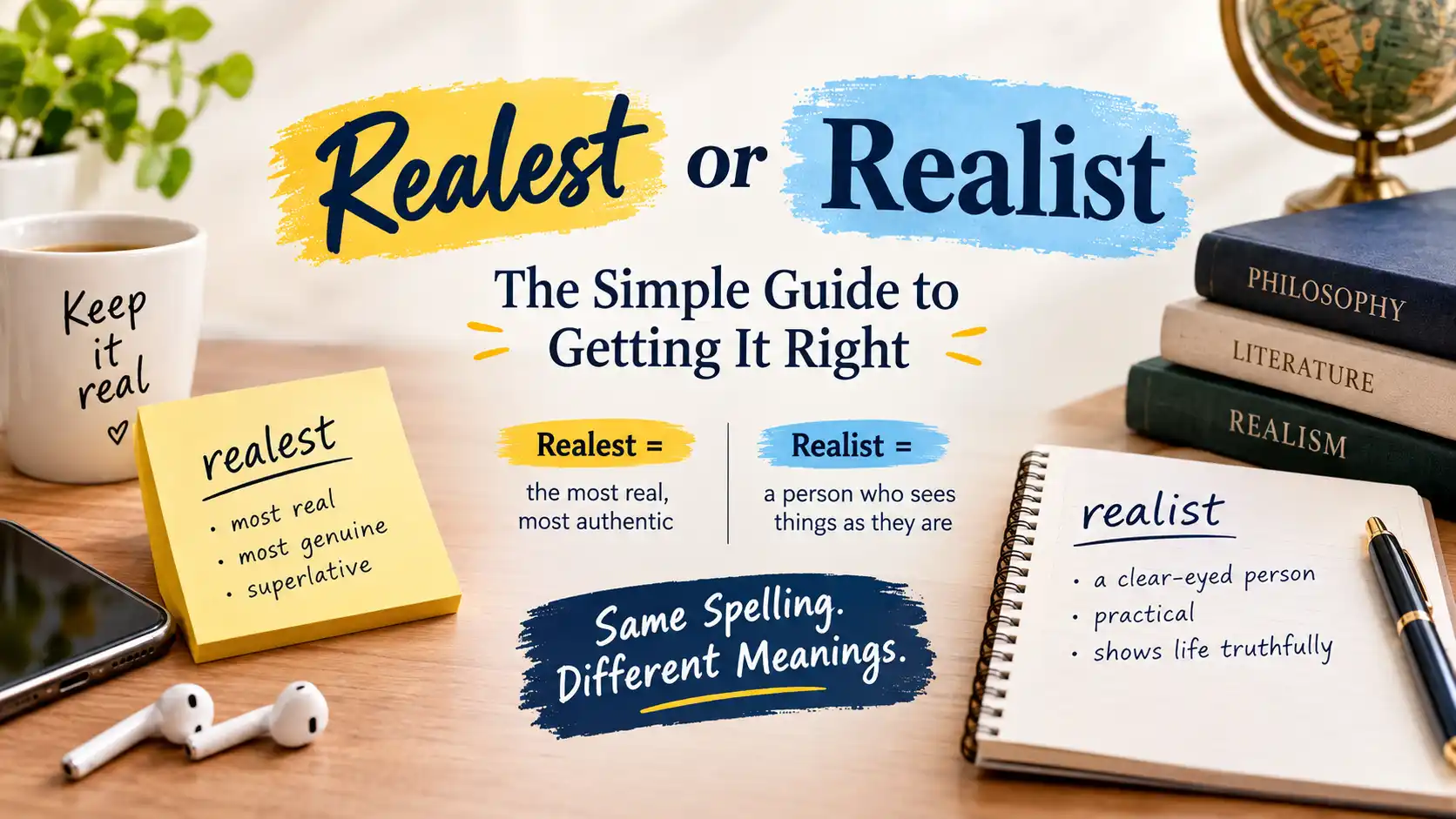
Here’s the good news: the difference is simple once you see it. Realest is the superlative form of “real” — it means “most real.” Realist is a noun (or adjective) describing a person who sees things as they truly are, without wishful thinking.
This guide breaks down both words, where they come from, how to use them correctly, and the mistakes to avoid. By the end, you’ll never second-guess yourself again.
Realest or Realist Quick Answer
Here’s the short version:
- Realest = the superlative of “real.” It means “most genuine” or “most authentic.” Example: “That was the realest advice I’ve ever gotten.”
- Realist = a person who accepts life as it is, not as they wish it to be. It can also describe art or writing that shows life truthfully. Example: “She’s a realist she plans for what’s likely, not what’s ideal.”
They are not spelling variants of the same word. They are two completely different words that happen to look and sound similar.
The Origin of Realest and Realist
Both words trace back to the Latin word realis, meaning “relating to things” the root of “real.”
- Realists entered English in the 1600s, first used in philosophy to describe people who believed in objective, external reality. Later, in the 1800s, it took on a second meaning in art and literature: showing life exactly as it is, without idealizing it.
- Realest is simply the superlative form of the adjective “real,” built the normal English way by adding “-est” to a short adjective (like “fast” becomes “fastest”). It became especially common in informal speech and hip-hop culture, where “keeping it real” and “the realest” describe authenticity and honesty.
So the confusion isn’t really about history or spelling. It’s about two words that sound alike but serve completely different jobs in a sentence one is an adjective, the other a noun.
British English vs American English Spelling
Here’s an important clarification: realest and realist are not British vs American spelling differences. Both words are spelled the same way in the UK, the US, Canada, Australia, and everywhere else English is spoken. There’s no “realer” British version or “realist” American version — the confusion is grammatical, not regional.
That said, English speakers do sometimes confuse the two because of how similar related “real-” words can look across dialects. Here’s a clear comparison:
| Word | Type | Meaning | Spelling (UK) | Spelling (US) |
| Realest | Adjective (superlative) | Most real, most genuine | realest | realest |
| Realist | Noun / adjective | A practical, clear-eyed person | realist | realist |
| Realism | Noun | The quality of being realistic | realism | realism |
| Really | Adverb | Truly, genuinely | really | really |
As the table shows, spelling stays identical worldwide. The only real “rule” to remember is grammatical: is the word describing a degree of realness (realest) or a type of person or style (realist)?
Which Spelling Should You Use?
Since spelling doesn’t change by region, the real question is: which word fits your sentence?
- Use “realest” when you’re comparing degrees of authenticity. It works best in casual, spoken, or informal writing texts, social posts, song lyrics, or conversational blog posts. Example: “He’s the realest friend I know.”
- Use “realist” when you’re describing a person, mindset, or artistic style. It fits formal writing, business emails, essays, and journalism. Example: “As a realist, she budgets for delays.”
- For global or professional audiences, lean toward “realist” unless you’re specifically writing in a casual, conversational tone where “realest” fits naturally.
- For informal, US-influenced pop culture content (social media captions, hip-hop-inspired writing, casual blogs), “realest” is widely understood and accepted.
Common Mistakes with Realest or Realist
- Using “realest” in formal writing. “She is the realest person in the office” sounds too casual for a business report. Use “most genuine” or “realist” instead.
- Using “realist” to mean “most real.” “That was the realist moment of the show” is incorrect — “realist” is not a superlative. The correct word here is “realest” or “most realistic.”
- Confusing “realist” with “realistic.” “Realist” describes a person or artistic style. “Realistic” describes something that resembles reality. Example: “That’s a realistic painting” (correct), not “That’s a realist painting” (unless referring to the Realism art movement specifically).
- Spelling errors like “realiest” or “reallist.” Neither spelling exists. Double-check before publishing.
- Overusing “realest” in professional emails. It reads as slang and can undercut credibility.
Realest or Realist in Everyday Examples
The In texts and social media:
“This is the realest thing I’ve read all week.”
In news and journalism:
“Economists remain realists about the risk of a slowdown.”
The In formal writing or essays:
“The realist school of thought rejects idealized assumptions about human behavior.”
In marketing or branding copy:
“Our realest reviews come straight from real customers.”
In everyday conversation:
“My grandmother is a total realist — she never sugarcoats anything.”
Notice the pattern: “realest” shows up in casual, emotional, or expressive contexts. “Realist” shows up in descriptive, analytical, or formal ones.
Realest or Realist Google Trends & Usage Data
Search interest in this exact comparison spikes mainly in the US and among younger, social-media-driven audiences, largely due to “realest” trending in music, streetwear, and pop culture captions. “Realist,” by contrast, sees more consistent global search volume, driven by philosophy, psychology, literature, and business content, where the word appears in formal contexts.
In short: “realest” is a US-leaning, informal, expression-driven term, while “realist” is a globally used, formal, descriptive term. Understanding this split helps you choose the right word for your audience and platform.
| Term | Common Context | Audience | Region Trend |
| Realest | Casual, expressive | Social media, music, youth culture | Strongest in the US |
| Realist | Formal, descriptive | Academic, business, journalism | Global, steady |
FAQs
1. Is “realest” a real word?
Yes. It’s the standard superlative form of “real,” just like “fastest” is the superlative of “fast.”
2. What’s the difference between realist and realistic?
“Realist” describes a person or a style (like Realism in art). “Realistic” describes something that resembles reality, such as a realistic drawing.
3. Can I use “realest” in formal writing?
It’s best avoided. Use “most genuine,” “most authentic,” or “realist” instead.
4. Is “realest” British or American English?
Neither — spelling is identical in both. The word itself is more commonly used in informal American English contexts.
5. What does “keeping it realest” mean?
It’s a casual expression meaning to be as honest and authentic as possible.
6. Is “realist” always a noun?
Mostly, yes, but it can also function as an adjective, as in “realist fiction” or “realist painting.”
7. Which word should I use in a resume or cover letter?
Use “realist” if describing your mindset (e.g., “a realist approach to problem-solving”). Avoid “realest” entirely in professional documents.
Conclusion
“Realest” and “realist” may look alike, but they play very different roles in English. “Realest” is the superlative of “real,” used to express maximum authenticity common in casual speech, music, and social media. “Realist,” on the other hand, is a noun (or adjective) describing someone who sees the world practically, or a style that reflects life truthfully common in formal, academic, and professional writing.
There’s no British vs American spelling divide here; both words are spelled the same everywhere. The real key is context: choose “realest” for casual, emotional expression, and “realist” for formal, descriptive writing.
When in doubt, ask yourself: am I comparing degrees of “realness” (realest), or describing a person or style (realist)? Answering that question will guide you to the right word every time no matter your audience or platform.

Sikandar Hayat is the author and creator of Journalneste.com, a website dedicated to heartfelt wishes, messages, greetings, and inspiring words for every special moment. With a passion for meaningful writing, Sikandar creates warm and thoughtful content that helps readers express their feelings with ease. His goal is to provide beautiful, shareable words for birthdays, celebrations, relationships, and memorable occasions.