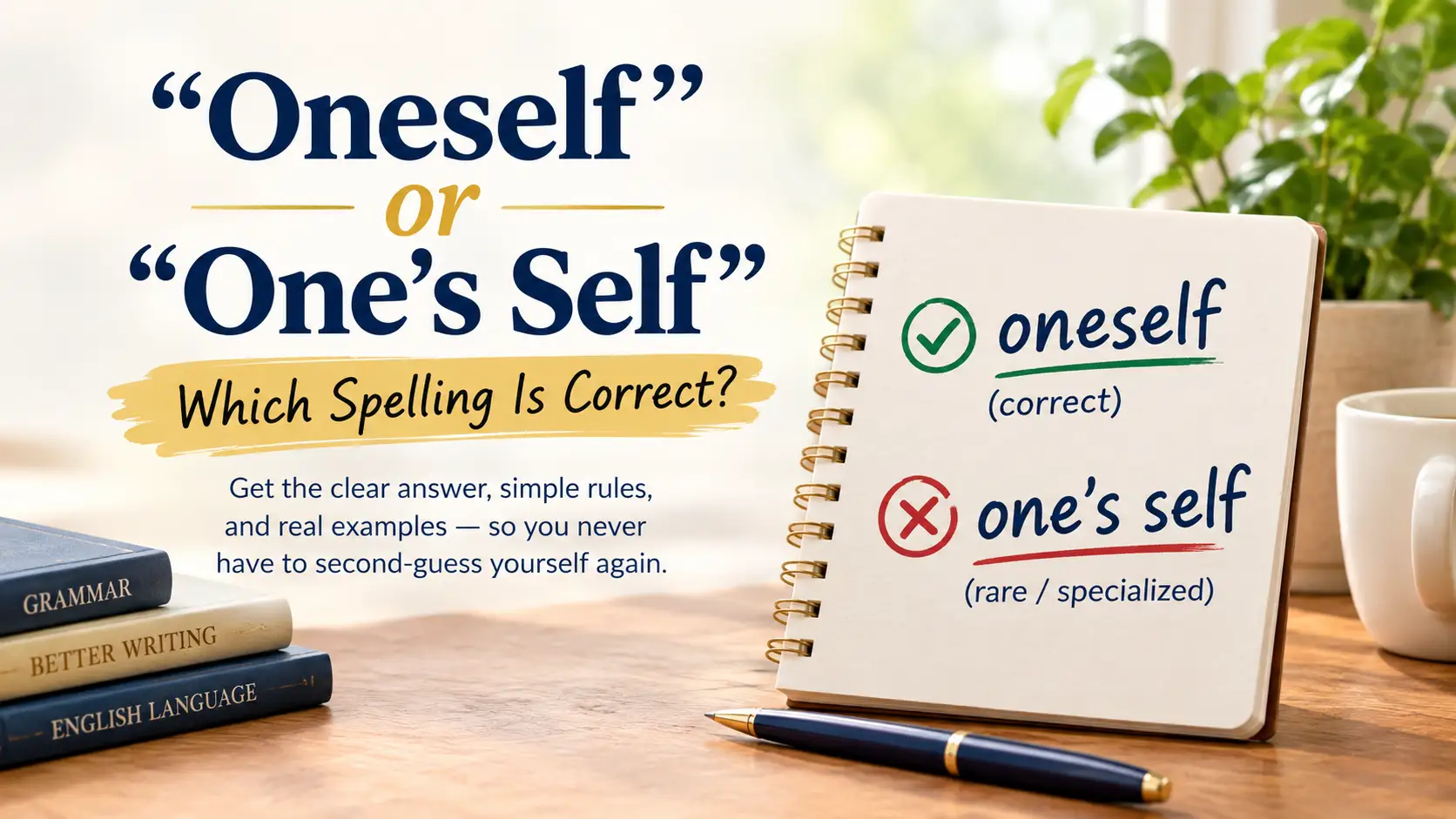
Ever paused mid-sentence, unsure If to write “oneself” or “one’s self”? You’re not alone. This tiny word trips up writers, students, and even professionals every day.
The confusion makes sense. English has plenty of words that split into two, like “myself” versus “my self,” so it’s natural to wonder if “oneself” follows the same pattern. Add in regional spelling differences between American and British English, and the confusion grows.
Most people searching this term want a fast, clear answer. They’re drafting an email, finishing a school essay, or double-checking a report before hitting send. They don’t want a grammar lecture. They want to know: which one is correct, and can I use it right now?
This article gives you that answer first, then walks through the history, the spelling rules, and real examples so you never have to second-guess yourself again.
“Oneself” or “One’s Self” Quick Answer
In almost every case, “oneself” is correct. It’s one word, no apostrophe.
- Correct: It’s important to believe in oneself.
- Incorrect: It’s important to believe in one’s self.
“One’s self” is only correct in rare cases where “self” is used as a standalone noun, usually in psychology or philosophy writing.
- Example: One’s self is shaped by experience. (Here, “self” means “identity” or “inner being.”)
For everyday writing, business emails, and school work, always default to oneself.
The Origin of “Oneself”
“Oneself” comes from the reflexive pronoun pattern in English, similar to “himself,” “herself,” and “themselves.” These words combine a pronoun with “self” to show that an action refers back to the subject.
Historically, English reflexive pronouns went through changes over centuries. Older forms sometimes appeared as two words, which is part of why “one’s self” still shows up in older texts or formal philosophical writing.
Modern English settled on the single-word form “oneself” for everyday reflexive use, matching the pattern of “myself” and “yourself.” The two-word version survived only in a narrower, more specific meaning, where “self” functions as a noun rather than part of a reflexive pronoun.
This history explains why some writers still hesitate. The two-word version isn’t wrong, it’s just used for a different purpose.
British English vs American English Spelling
Good news: spelling rules for this word don’t differ between British and American English. Unlike words like “colour” versus “color,” “oneself” stays the same on both sides of the Atlantic.
| Feature | British English | American English |
| Standard reflexive form | oneself | oneself |
| Noun form (rare) | one’s self | one’s self |
| Common in formal writing | Yes | Yes |
| Common in casual writing | Less common | Less common |
The real difference isn’t regional. It’s about usage context, reflexive pronoun versus standalone noun, not country.
Which Spelling Should You Use?
Here’s simple, audience-based advice:
- US writers: Use “oneself” for nearly all writing, business, academic, casual.
- UK and Commonwealth writers (Canada, Australia, India, etc.): Same rule applies. Use “oneself” by default.
- Academic or philosophical writing (any region): You may see “one’s self” when the author means “a person’s identity,” but this is rare and specialized.
- General global audience: When in doubt, choose “oneself.” It’s correct 95% of the time.
If you’re not writing about psychology, identity, or philosophy, you almost never need “one’s self.”
Common Mistakes with “Oneself”
- Adding an apostrophe by habit
Wrong: One should take care of one’s self.
Right: One should take care of oneself. - Splitting it into two words in casual writing
Wrong: It’s hard to see one’s self clearly.
Right: It’s hard to see oneself clearly. - Confusing it with “himself/herself” structure
Some writers think “one’s self” matches “his self” or “her self,” but those aren’t standard forms either. The correct forms are “himself” and “herself,” one word. - Overusing “one” in modern writing
“One” can sound formal or old-fashioned. In casual writing, consider rewording with “you” or “yourself” instead.
Example: You should believe in yourself often reads more naturally than One should believe in oneself.
“Oneself” in Everyday Examples
In emails:
Please remember to save a copy for oneself before submitting the form.
(More natural: Please remember to save a copy for yourself.)
In news writing:
Financial experts recommend setting aside savings to protect oneself during uncertain times.
In social media:
Self-care isn’t selfish. Taking time for oneself is necessary.
In formal or academic writing:
The philosopher argued that understanding oneself is the first step toward wisdom.
(Here, the two-word “one’s self” might appear if the writer means the concept of identity: understanding one’s self as separate from society.)
These examples show “oneself” fits naturally into nearly any writing style, while “one’s self” stays limited to specific, reflective contexts.
“Oneself” Google Trends & Usage Data
Search interest in “oneself” tends to be steady rather than seasonal, since it’s a grammar question people look up whenever they’re writing, not tied to holidays or events.
General patterns show:
- Higher search volume in English-speaking countries with strong formal writing cultures, including the US, UK, Canada, Australia, and India.
- Frequent searches paired with terms like “grammar,” “correct spelling,” and “reflexive pronoun.”
- Searches for “one’s self” are far less common, confirming it’s a niche form most people don’t need.
This data confirms what the grammar rules already show: “oneself” is the dominant, standard form across regions and use cases.
Keyword Variations Comparison Table
| Form | Correct Usage | Frequency | Example |
| Oneself | Reflexive pronoun (default) | Very common | Take care of oneself. |
| One’s self | Standalone noun (identity) | Rare | One’s self is complex. |
| One self | Incorrect / typo | Not standard | Avoid entirely |
| Ones self | Incorrect / missing apostrophe | Not standard | Avoid entirely |
FAQs
1. Is “oneself” one word or two?
“Oneself” is one word. It’s the standard reflexive pronoun form used in almost all writing.
2. Is “one’s self” ever correct?
Yes, but only when “self” is used as a noun meaning identity or inner being, usually in academic or philosophical writing.
3. Do British and American English spell it differently?
No. Both use “oneself.” Spelling doesn’t change by region for this word.
4. Why do people confuse “oneself” with “one’s self”?
Because reflexive pronouns like “myself” and “yourself” sometimes seem like they could split apart, and older texts occasionally used the two-word form.
5. Can I use “oneself” in casual writing?
Yes, though “yourself” often sounds more natural and modern in casual contexts.
6. What’s the difference between “oneself” and “himself”?
They follow the same reflexive pattern. “Oneself” refers to a general, unspecified person, while “himself” refers to a specific male subject.
7. Is “oneself” formal or informal?
It is formal. It’s common in academic, professional, and instructional writing, less common in everyday conversation.
Conclusion
“Oneself” is the correct choice almost every time you need a reflexive pronoun referring to a general or unspecified person. Write it as one word, no apostrophe, no space.
“One’s self” exists, but it serves a narrow purpose: describing identity or inner being as a noun, mostly in academic or philosophical writing. Unless you’re specifically discussing the concept of “self” as an idea, you don’t need it.
Spelling doesn’t change between American and British English for this word, so there’s no regional rule to memorize. The real decision comes down to context: are you using “self” as part of a reflexive pronoun, or as a standalone noun?
For business writing, emails, essays, and everyday communication, default to “oneself.” It’s simpler, more common, and always safe. Keep this guide handy, and you’ll never second-guess this word again.

Sikandar Hayat is the author and creator of Journalneste.com, a website dedicated to heartfelt wishes, messages, greetings, and inspiring words for every special moment. With a passion for meaningful writing, Sikandar creates warm and thoughtful content that helps readers express their feelings with ease. His goal is to provide beautiful, shareable words for birthdays, celebrations, relationships, and memorable occasions.