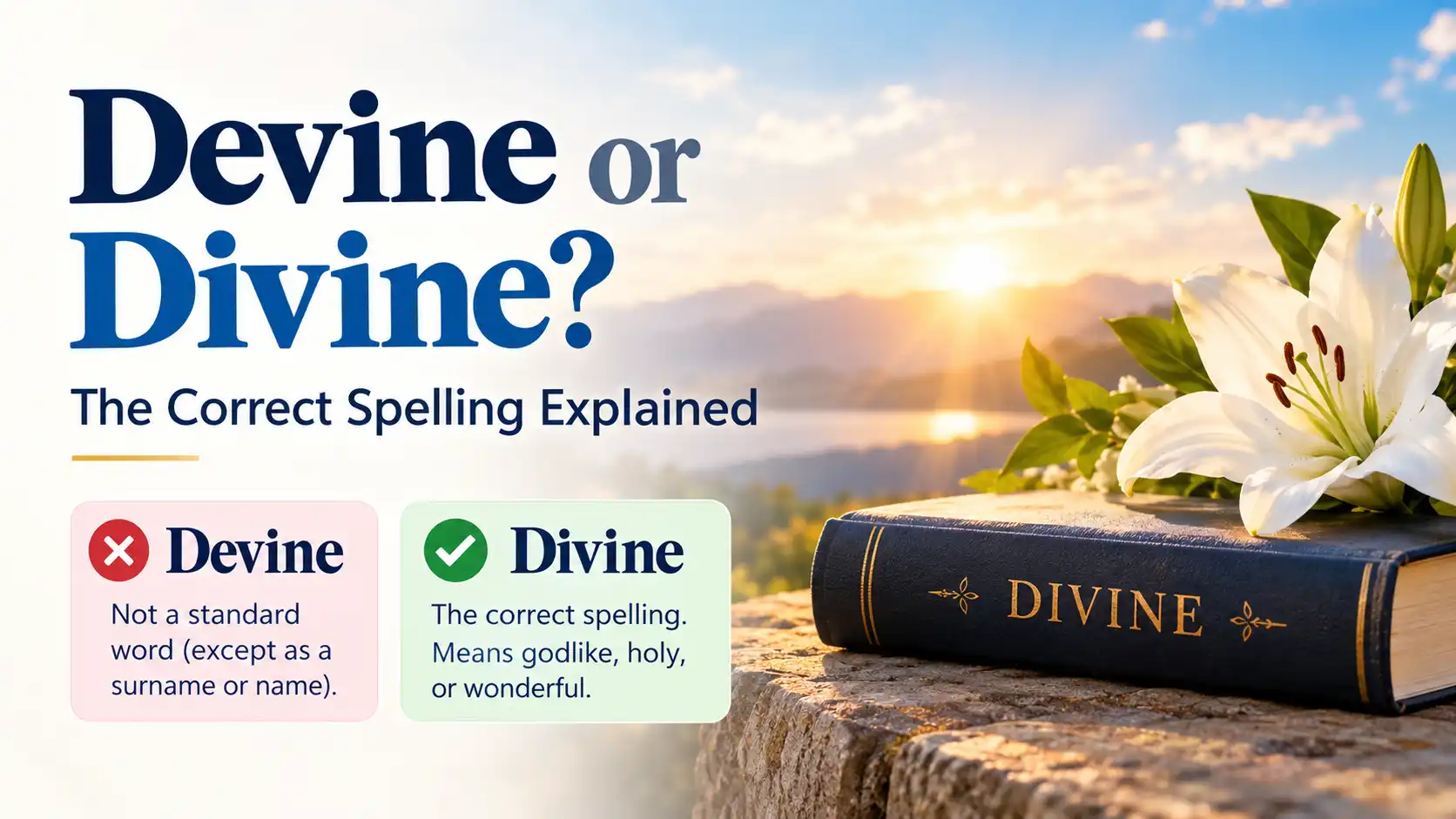
You are writing a sentence. You want to say something is godlike, holy, or just wonderful. Then you stop. Is it “devine” or “divine”?
You are not alone. Thousands of people type this question into Google every month. The two words look almost the same. They sound the same too. A tired brain can easily swap one letter.
People search for this keyword for a simple reason. They want a fast, safe answer. They do not want a typo in a school paper, a work email, or a social media post.
This article clears up the confusion. You will get the short answer first. Then you will learn where the words come from, why the mix-up happens, and which spelling to use. You will also see real examples, common mistakes, and a list of questions people often ask.
By the end, you will never doubt this spelling again. Let’s start with the answer.
Devine or Divine Quick Answer
Use “divine.” It is the correct spelling in American English, British English, and every other form of English.
“Divine” has two main jobs:
- Adjective: Godlike, holy, or wonderful. The cake was divine.
- Verb: To guess or find out by feeling or magic. She tried to divine the future.
“Devine” is not a standard English word. You will only see it as a surname or a name, like the actor Loretta Devine or the Irish family name Devine.
More examples:
- ✅ The church held a divine service.
- ✅ That sunset looks divine.
- ✅ Mr. Devine will join us at noon. (a person’s name)
- ❌ The view was devine.
The Origin of Divine
“Divine” comes from the Latin word divinus, which means “of a god.” That word comes from divus, meaning “god” or “godlike.”
The word then moved into Old French. There, a related word, devin, meant a person who could see the future. Old French often used an “e” where Latin had an “i.”
English was borrowed from French after 1066. In the Middle Ages, spelling was not fixed. Writers spelled the same word many ways. You could see “devyne,” “devine,” and “divine” in old books.
Later, printing spread. Printers and scholars wanted to match the Latin form. So “divine” won.
This is why the mix-up still happens today. “Devine” is a ghost of old spelling. It also exists as a surname, which keeps it in front of our eyes.
British English vs American English Spelling
Here is the good news. There is no British versus American split for this word. Both use “divine.”
Many word pairs do differ, like color and colour. But “divine” is not one of them.
| Word | American English | British English | Notes |
| Godlike or wonderful | divine | divine | Same everywhere |
| To guess or foresee | divine | divine | Same everywhere |
| Related noun | divinity | divinity | Same everywhere |
| Related adverb | divinely | divinely | Same everywhere |
| Surname | Devine | Devine | A name, not a word |
| Color (for comparison) | color | colour | Real US/UK difference |
So if you are choosing a spelling by country, you can relax. The answer never changes.
Which Spelling Should You Use?
Always pick divine for the word. The only time you write “Devine” is when it is someone’s name.
If your reader is American: Use “divine.”
And if your reader is British, Australian, Indian, or Canadian: Use “divine.”
If you are writing a person’s name: Use “Devine,” with a capital D, and only if that is how they spell it. Always check.
A simple tip: if you can replace the word with “holy” or “wonderful,” write “divine.”
Common Mistakes with Devine or Divine
1: Writing “devine” for “divine.”
- ❌ The food was devine.
- ✅ The food was divine.
2: Dropping the capital in a name.
- ❌ I met john devine.
- ✅ I met John Devine.
3: Mixing it up with “define.”
- ❌ Please divine the term. (when you mean “define”)
- ✅ Please define the term.
4: Trusting spell check blindly.
“Devine” may pass as a name. Your tool may not flag it. Read it twice.
5: Wrong ending.
- ❌ devinely, devinity
- ✅ divinely, divinity
Devine or Divine in Everyday Examples
Email:
- “The team lunch was divine. Thank you for planning it.”
- “Please send the file to Ms. Devine.” (a name)
News:
- “Fans called the singer’s voice divine.”
- “Devine scored twice in the second half.” (a player’s surname)
Social media:
- “Sunday brunch = divine 😍”
- “Shoutout to my friend Sam Devine!”
Formal writing:
- “Many faiths teach about divine mercy.”
- “The king claimed a divine right to rule.”
Devine or Divine Google Trends & Usage Data
I can’t pull live Google Trends numbers here, so I won’t invent any. Here is what is safe to say, and how you can check it yourself.
What we can say:
- “Divine” is by far the more common word in books, news, and daily writing.
- “Devine” shows up mostly as a surname, in places with Irish heritage such as Ireland, the UK, the US, and Australia.
- Searches for “devine or divine” usually come from students, writers, and people typing fast on phones.
How to check: Visit Google Trends, enter “devine” and “divine,” and compare by country and date. Try the “Related queries” box too.
| Variation | Is it a real word? | Common use | Where you see it |
| divine | Yes | Godlike, wonderful, to foresee | Worldwide |
| devine | No | Surname or given name | Mostly names |
| Devine | No (name only) | Person or family | Ireland, UK, US, Australia |
| divinely | Yes | In a godlike way | Worldwide |
| divinity | Yes | God or a god-like state | Worldwide |
| devinely / devinity | No | Typos | Misspellings |
FAQs
1. Is it devine or divine?
It is “divine.” “Devine” is only a surname.
2. Is “devine” ever correct?
Yes, but only as a name, like Loretta Devine. It is never correct as a regular word.
3. Is there a British spelling of divine?
No. British and American English both use “divine.”
4. What does divine mean?
It means godlike, holy, or wonderful. As a verb, it means to guess or discover.
5. Why do people write “devine”?
The words sound the same. Also, “devine” was a real old spelling long ago, and it lives on in names.
6. Is “divine” a verb?
Yes. “She used a stick to divine water” means she searched for water by feel.
7. What is a good way to remember it?
Think of the “i” in “divine” and the “i” in “holy light.” Or remember: divine has two i’s, like wine is fine.
Conclusion
Here is what to remember.
The right spelling is divine. It works in American English, British English, and everywhere else. There is no country split to worry about.
“Divine” means godlike, holy, or wonderful. It can also mean to guess or foresee something. You can use it for food, music, faith, or a lovely view.
“Devine” is not a regular word. It is a surname and a name. Only write it with a capital D when you mean a person, and check the spelling of their name first.
The mix-up happens for good reasons. The words sound alike. Old English writers used many spellings. And the name Devine still appears in daily life.
Before you hit send, do a quick check. Can you swap the word for “holy” or “wonderful“? Then write “divine.” Is it a person’s name? Then write “Devine.”
That is all you need. Now you can write with confidence, If it is an email, an essay, or a post.

Sikandar Hayat is the author and creator of Journalneste.com, a website dedicated to heartfelt wishes, messages, greetings, and inspiring words for every special moment. With a passion for meaningful writing, Sikandar creates warm and thoughtful content that helps readers express their feelings with ease. His goal is to provide beautiful, shareable words for birthdays, celebrations, relationships, and memorable occasions.