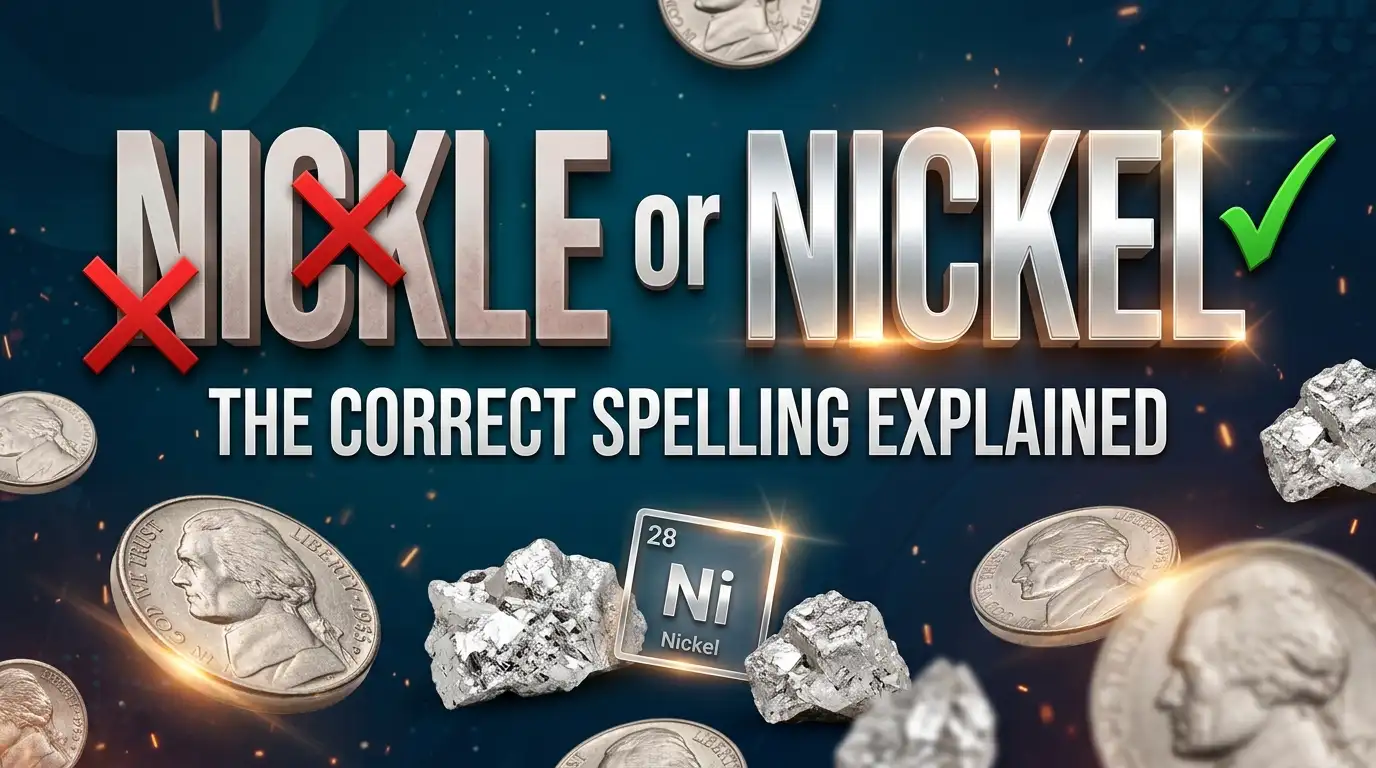
You are typing a sentence. You need the word for the five-cent coin, or the silver-white metal. Then you stop. Is it “nickle” or “nickel”? Both look right. That small doubt is why so many people search “nickle or nickel.”
Here is the good news. The answer is simple. “Nickel” is the correct spelling. It is the same in American, British, and Canadian English. There is no regional split here.
So why the confusion? Many English words end in “-le,” like “little,” “uncle,” and “circle.” Our eyes expect that pattern. Some famous names also use “Nickle,” like a surname or a gallery. That adds to the mix.
In this guide, you will get a quick answer first. Then you will learn where the word came from, which spelling to use, common mistakes, real examples, and usage trends. By the end, you will never second-guess it again.
Nickle or Nickel Quick Answer
Use “nickel.” It ends in -el, not -le.
“Nickel” has two main meanings:
- A metal. Nickel is a hard, silver-white element used in steel, batteries, and coins.
- A coin. In the US and Canada, a nickel is a five-cent coin.
Examples:
- “This pan has a nickel coating.”
- “Do you have a nickel for the meter?”
- “The battery uses nickel and cobalt.”
“Nickle” is not a standard word. If you see it, it is a typo or a name.
The Origin of Nickel
The word is old. It comes from German miners.
In the 1600s, miners in Saxony found a red-brown ore. It looked like copper. But it gave no copper. They blamed a mischievous spirit named “Nick” or “Old Nick.” They called the ore Kupfernickel. That means “copper demon” or “false copper.”
In 1751, Swedish chemist Axel Fredrik Cronstedt got a new metal from this ore. He shortened the name to “nickel.” The name stuck.
The coin came later. In the US, the five-cent coin got the nickname “nickel” because it contained the metal. Today it is mostly copper, with about 25 percent nickel.
Why do spelling mistakes happen? The “-el” ending is less common than “-le” in everyday words. People write what looks familiar. Typing fast also swaps the two letters.
British English vs American English Spelling
Some words differ across the Atlantic. Think “color” and “colour.” But “nickel” is not one of them.
| Word | American English | British English |
| Metal (element) | nickel | nickel |
| Five-cent coin | nickel | nickel (rarely used) |
| Color | color | colour |
| Center | center | centre |
| Traveling | traveling | travelling |
| Nickle | not standard | not standard |
The rule: Both countries spell it “nickel.” The only difference is use. Americans say “nickel” for a coin. In Britain, there is no five-cent coin, so the coin sense is rare. The metal sense is common in both.
Which Spelling Should You Use?
Use “nickel” everywhere. Here is the advice by audience.
- US readers: Use “nickel.” It works for the coin, the metal, and phrases like “nickel and dime.”
- UK and Commonwealth readers: Use “nickel.” It is the standard in science, trade, and industry.
- Canadian readers: Use “nickel.” Canada also has a five-cent coin called the nickel.
- Global readers: Use “nickel.” Search engines, dictionaries, and style guides all use it.
The only time to use “Nickle” is when it is part of a proper name. Keep the spelling that the person or place uses.
Common Mistakes with Nickel
Mistake 1: Writing “nickle” for the coin.
Wrong: “I found a nickle.”
Right: “I found a nickel.”
Mistake 2: Writing “nickle” for the metal.
Wrong: “The ring is nickle-plated.”
Right: “The ring is nickel-plated.”
Mistake 3: Writing “nickle and dime.”
Wrong: “They nickle and dime customers.”
Right: “They nickel-and-dime customers.”
Mistake 4: Trusting the “-le” pattern.
Not every word ends in “-le.” Memory trick: Nickel starts with “Nick,” the spirit from the origin story. Nick is spelled with an e before the l at the end of the word: nick-el.
Mistake 5: Changing a proper name.
If a person is named “Nickle,” do not “fix” it.
Nickel in Everyday Examples
Email:
“Please check the product specs. The handle is stainless steel with a nickel finish.”
News headline:
“Nickel prices rise as electric car demand grows.”
Social media:
“Found a nickel on the street today. Lucky day!”
Formal writing:
“Nickel is a key component in many stainless steel alloys.”
Common phrases:
- “Not worth a plugged nickel” means almost worthless.
- “To nickel-and-dime” means to charge small fees again and again.
- “Don’t take any wooden nickels” is an old saying. It means don’t be fooled.
Nickle or Nickel Google Trends & Usage Data
I can’t pull live Google Trends numbers here, so I won’t make up figures. You can check them free at trends.google.com. Here is the pattern you will likely see, based on how the word is used.
- “Nickel” is far more common. It is the standard spelling in books, news, and science.
- “Nickle” shows up mostly as a typo. Some searches are also for names and places.
- The US is a strong source of interest. The coin and slang use keep the word popular there.
- Industry news boosts interest. Stories on batteries, EVs, and mining can lift searches for “nickel.”
- Canada also searches for the word. It has its own five-cent coin.
Tip: In Google Trends, compare “nickel” and “nickle” side by side. Then filter by country and time period.
Keyword variations side by side
| Variation | Correct? | Meaning | Example |
| nickel | Yes | Metal or five-cent coin | “A nickel is worth five cents.” |
| nickle | No (typo) | None in standard English | Avoid in writing |
| Nickle (capital N) | Only as a name | Surname or place name | “Nickle Galleries” |
| nickel-plated | Yes | Coated with nickel | “A nickel-plated key” |
| nickel and dime | Yes | Small, repeated charges | “Stop nickel-and-diming me.” |
| nickle and dime | No | Misspelled phrase | Use “nickel” instead |
FAQs
1. Is it nickle or nickel?
It is “nickel.” The spelling ends in -el.
2. Is “nickle” ever correct?
Not as a common word. It is correct only as part of a name, like a surname.
3. Is there a UK vs US spelling difference for nickel?
No. Both use “nickel.”
4. Why is a five-cent coin called a nickel?
The coin contains nickel metal. People shortened the name to “nickel.”
5. How much nickel is in a US nickel?
About 25 percent. The rest is mostly copper.
6. Where does the word come from?
It comes from the German word Kupfernickel, meaning “copper demon.” Miners gave it that name. Cronstedt later shortened it.
7. What is a good way to remember the spelling?
Think of “Nick” plus “el.” Nick-el. The e comes before the l.
8. Do search engines understand “nickle”?
Usually yes. They guess you mean “nickel.” But you should still write “nickel.”
Conclusion
The question “nickle or nickel” has a clear answer. Nickel is the right spelling. It works in the US, the UK, Canada, and everywhere else. There are no regional rules to remember.
Here are the key points:
- “Nickel” means a metal and a five-cent coin.
- The word comes from the German Kupfernickel, “copper demon.”
- “Nickle” is a typo, unless it is part of a name.
- Phrases like “nickel-and-dime” use the same spelling.
- A quick memory trick helps: Nick + el.
When you write for work, school, or social media, use “nickel.” It looks professional. This matches dictionaries. It helps readers trust your writing.
If you are unsure again, check a dictionary. Or compare the two terms in Google Trends. You will see which one the world uses.
Small spelling choices matter. Now you know the right one. Write with confidence.

Sikandar Hayat is the author and creator of Journalneste.com, a website dedicated to heartfelt wishes, messages, greetings, and inspiring words for every special moment. With a passion for meaningful writing, Sikandar creates warm and thoughtful content that helps readers express their feelings with ease. His goal is to provide beautiful, shareable words for birthdays, celebrations, relationships, and memorable occasions.