You are typing a text. You want to say your friend always cancels plans. Is he flaky? Or flakey? You stop and stare at the screen. Sound familiar?
You are not alone. Many people search this question every month. The word looks simple, but the ending trips people up. Should there be an “e” before the “y” or not?
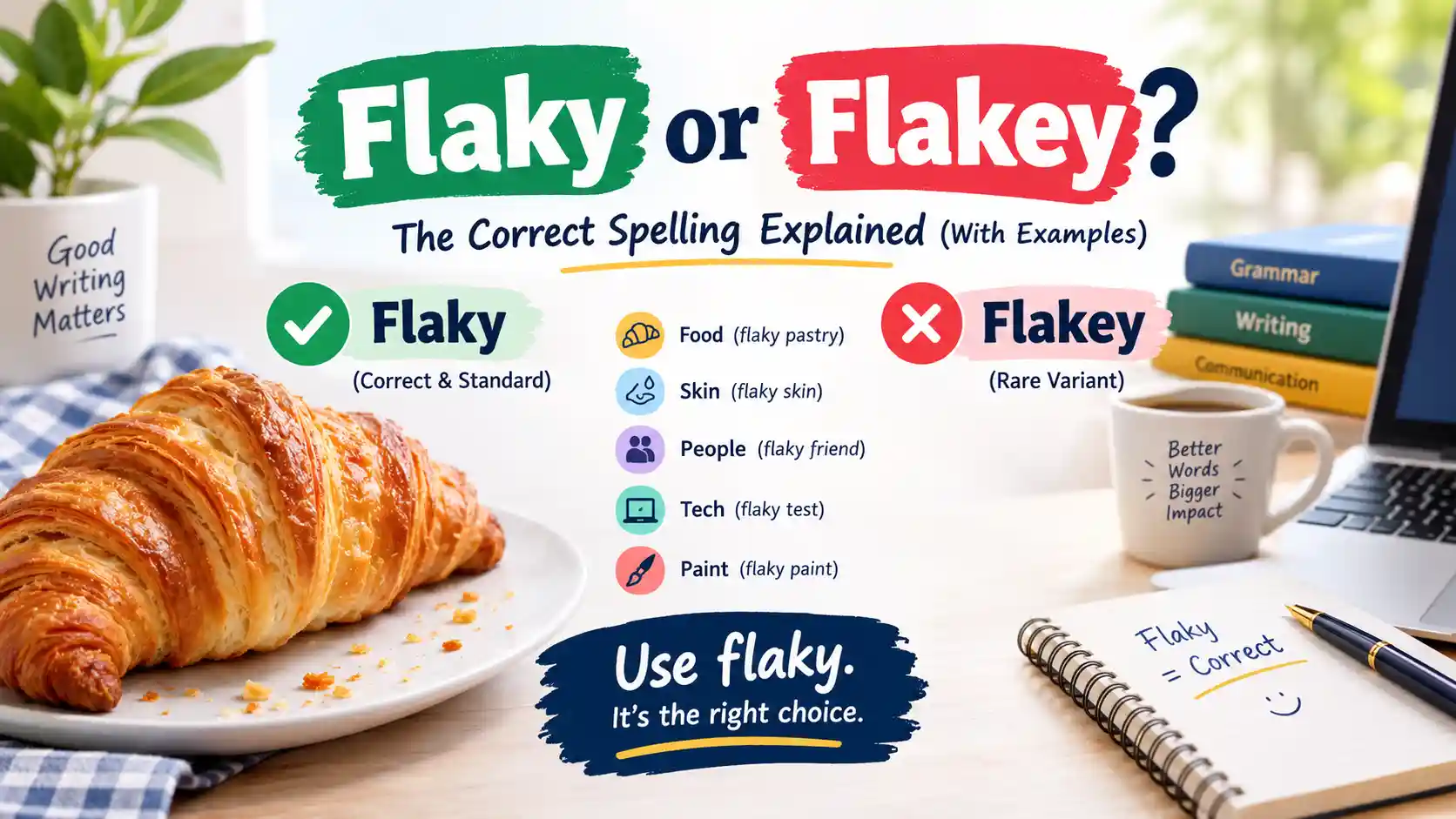
This guide clears it up fast. Here is the short answer: flaky is the correct spelling. Flakey is a rare variant that most editors will fix.
You will learn why two spellings exist. The you will see how the US and UK treat them. You will also see real examples from emails, news, and social media. We will cover common mistakes, a clear comparison table, and a full FAQ.
By the end, you will know which spelling to pick and why. You will never second-guess yourself again. If you write for school, work, a blog, or a text to a friend, you will have a clear answer. Let’s start.
Flaky or Flakey Quick Answer
Use flaky. It is the standard spelling in American English, British English, and almost every style guide.
Flakey shows up now and then. Some dictionaries list it as a variant. But it is much less common, and many readers will see it as a typo.
Here are the main meanings of flaky:
- Food: A flaky pie crust has thin, light layers. “The croissant was warm and flaky.”
- Skin: Dry skin that comes off in small bits. “My scalp feels flaky in winter.”
- People: Someone who is not reliable. “He is so flaky. He never shows up.”
- Tech: A test or app that works sometimes and fails other times. “We have a flaky test in our code.”
- Paint: Paint that peels off in small pieces.
All four meanings use the same spelling: flaky.
The Origin of Flaky (and Why Flakey Exists)
The word starts with flake. A flake is a small, thin piece of something. Think of a snowflake or a flake of paint. The word flake is old. It likely came into English from Scandinavian languages hundreds of years ago.
Add -y to a noun and you often get a describing word. Snow becomes snowy. Rain becomes rainy. Flake becomes flaky, meaning “full of flakes” or “like a flake.”
The “person” meaning is newer. In the mid-1900s, American speakers began using flake and flaky for someone odd or unreliable. Later, the word also came to mean a person who breaks plans. Tech workers then borrowed it for tests and systems that fail without warning.
So why does flakey exist? There are a few reasons:
- Silent “e” confusion. The word flake ends in “e.” Some writers keep it by habit.
- Look-alike words. English has words like hockey, key, monkey, and pokey. The “-ey” ending feels normal.
- Brand names and nicknames. Sellers sometimes pick odd spellings to look fun.
- Spelling rules are loose. English has many exceptions, so people guess.
The usual rule is simple. When a word ends in a silent “e,” drop the “e” before adding “-y.” That gives us shake → shaky, snake → snaky, and flake → flaky.
British English vs American English Spelling
Here is the good news. Flaky is the main spelling in both the US and the UK. This is not like color and colour. Both sides agree.
Some “-y / -ey” words do differ by region or have two accepted forms. Compare:
| Word | Standard Form | Variant | Notes |
| flaky | flaky | flakey | Both US and UK prefer flaky |
| shaky | shaky | shakey | Shaky is standard everywhere |
| smoky | smoky | smokey | Smoky is more common; smokey is a variant |
| cagey | cagey | cagy | Both forms are accepted |
| pokey | pokey | poky | Both forms are accepted |
| grey / gray | grey (UK) | gray (US) | A true UK vs US split |
The lesson is clear. Flaky is not a UK vs US issue. It is a “standard vs variant” issue. The standard form wins in both places.
Which Spelling Should You Use?
Here is simple advice by audience.
If you write for a US audience: Use flaky. American dictionaries and style guides prefer it.
If you write for a UK or Commonwealth audience: Use flaky. British, Canadian, Australian, and Indian English all use it too.
If you write for a global audience: Use flaky. It is the safest choice for blogs, websites, and company writing.
If you write code or tech docs: Use flaky. Phrases like “flaky test” and “flaky build” are standard in the field. Searching for them is easier with the usual spelling.
If you write a brand name or a joke: You can use flakey on purpose. Just know that readers may think it is a mistake.
When in doubt, drop the “e.”
Common Mistakes with Flaky
Here are the errors people make most, and how to fix them.
| Mistake | Fix | Why |
| He is so flakey. | He is so flaky. | Drop the “e” from flake |
| The crust was flaikey. | The crust was flaky. | The base word is flake |
| She is a flakey friend. | She is a flaky friend. | Standard spelling |
| Our tests are flakey. | Our tests are flaky. | Standard in tech writing |
| A flaky is someone who cancels. | A flake is someone who cancels. | Flaky is a describing word; flake is the noun |
| Flakiness spelled “flakeyness” | Flakiness | The “y” changes to “i” before -ness |
Two tips can help:
- Say the base word first: flake. Then drop the “e” and add “y.”
- For flakiness, change the “y” to “i,” just like happy → happiness.
Flaky in Everyday Examples
In an email:
“Sorry for the late reply. My internet has been flaky all week.”
In a work message:
“The login test is flaky. It fails about one in ten runs.”
In news writing:
“The bakery is known for its flaky pastries and long lines.”
On social media:
“Don’t be flaky. Show up for your friends.”
In a text to a friend:
“Sorry, I know I’m being flaky. Can we try Friday?”
In formal writing:
“The data showed flaky results, so the team repeated the study.”
In a recipe blog:
“For a flaky crust, keep your butter very cold.”
In every case, the spelling stays the same.
Flaky Google Trends & Usage Data
I did not pull live Google Trends numbers for this article, so I will not invent any. You can check them yourself in a minute. Here is what you will usually find, and how to read it.
Flaky is far more searched and used than flakey. In most English-speaking countries, such as the US, UK, Canada, Australia, and India, flaky leads by a very wide margin. Flakey appears as a small share of searches, often from people checking their spelling.
Usage depends on context:
- Food searches: “flaky pie crust” and “flaky pastry” are very common.
- Skin care searches: “flaky scalp” and “flaky skin” are common, especially in colder months.
- Social searches: “flaky friend” and “flaky people” are common in dating and friendship talk.
- Tech searches: “flaky tests” is popular among software teams.
How to check: Go to Google Trends and type “flaky” and “flakey” side by side. Pick a country and a time range. The chart will show you the gap right away.
Here is how the two compare:
| Feature | Flaky | Flakey |
| Standard in US dictionaries | Yes | Variant only |
| Standard in UK dictionaries | Yes | Variant only |
| Used in tech writing | Yes | Rare |
| Used in food writing | Yes | Rare |
| Seen as a typo by editors | No | Often |
| Safe for professional writing | Yes | No |
| Related forms | flakier, flakiest, flakiness | flakeyer (not standard) |
FAQs
1. Is it flaky or flakey?
Flaky is the correct and standard spelling. Flakey is a rare variant.
2. Is flakey ever correct?
Some dictionaries list it as a variant. Still, most editors and style guides prefer flaky. It is best to avoid flakey.
3. Is flaky spelled differently in the UK and the US?
No. Both use flaky. The spelling is the same around the English-speaking world.
4. What does flaky mean?
It can mean made of thin layers (a flaky crust), shedding small bits (flaky skin), unreliable (a flaky friend), or inconsistent (a flaky test).
5. What is the plural or noun form?
The noun is flake. A person who cancels plans can be called “a flake.” The state of being flaky is flakiness.
6. What are the comparative forms?
Use flakier and flakiest. For example: “This crust is flakier than the last one.”
7. Why do we drop the “e” in flaky?
English often drops a silent “e” before adding “-y.” That is why we write shaky, snaky, and flaky.
8. Can I use flakey in a brand name?
Yes, if you want to. Just know many readers will see it as a misspelling.
Conclusion
Here is what to remember. Flaky is the correct spelling. It works in the US, the UK, and everywhere else. Flakey is a rare variant. Most editors will mark it as an error.
The word comes from flake, a small, thin piece of something. When you add “y,” you drop the silent “e.” That follows the same rule as shaky and snaky. For related forms, use flakier, flakiest, and flakiness.
Use flaky food, skin, people, and tech. It fits emails, news, social posts, and formal papers. If you want a quick test, say the base word, drop the “e,” and add “y.”
Do not worry about British versus American rules here. Unlike color and colour, this word has one clear winner. When you are unsure, pick flaky. Your writing will look clean, correct, and professional.
Now you can type that message to your friend with confidence. Just don’t be flaky about it!

Sikandar Hayat is the author and creator of Journalneste.com, a website dedicated to heartfelt wishes, messages, greetings, and inspiring words for every special moment. With a passion for meaningful writing, Sikandar creates warm and thoughtful content that helps readers express their feelings with ease. His goal is to provide beautiful, shareable words for birthdays, celebrations, relationships, and memorable occasions.