You are typing a message. Your hand stops. Is it “sleave” or “sleeve”? You are not alone. Many people ask this every month, and the confusion is easy to understand.
The two words sound the same. English spelling is full of odd rules, so a wrong guess feels natural. Some people think “sleave” is a British spelling. Others think it is a typo. Some have seen it in an old book and wonder if it is still right.
This guide gives you the answer fast. You will learn which spelling is correct, where the odd one came from, and when each is used. The you will see simple examples, a comparison table, and common mistakes. You will also see how to pick the right word for your reader.
Here is the short version. “Sleeve” is the standard spelling in both American and British English. “Sleeping” is rare. It has a few special uses. By the end of this article, you will never second-guess your spelling again. Let’s clear it up.
Sleave or Sleeve Quick Answer
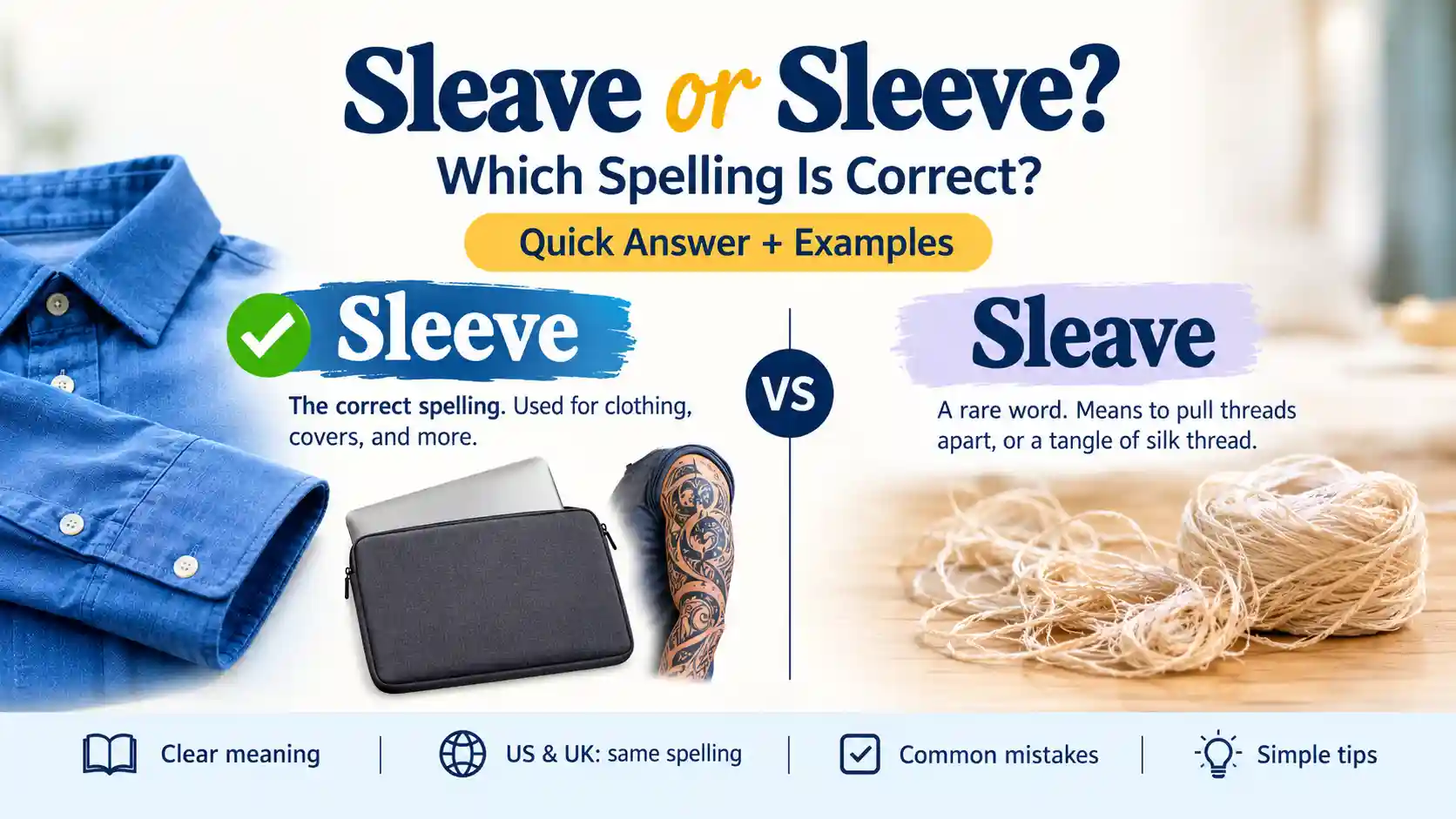
Use “sleeve.” It is the correct spelling in American, British, Canadian, and Australian English. A sleeve is the part of a shirt or jacket that covers your arm. The word also names a cover for a phone, a laptop, or a record.
“Sleave” is not a spelling difference between countries. It is a separate, very rare word. It means to pull threads apart, or a tangle of silk thread. Most people will never need it.
Examples:
- Correct: She rolled up her sleeve.
- Correct: I bought a new laptop sleeve.
- Correct: He has a tattoo sleeve.
- Wrong: She rolled up her
sleeve. - Rare but real: The weaver began to leave the silk.
The Origin of Sleave or Sleeve
“Sleeve” comes from Old English. Early forms looked like slēf and slīefe. The word has named the arm part of clothing for over a thousand years.
Spelling was not fixed in those days. There were no school dictionaries. Writers spelled words how they sounded to them. So you could find forms like sleve, slefe, and sleave for the same thing. Printing and dictionaries slowly locked the spelling into “sleeve.”
Why does “sleave” look right to some people? Look at its neighbors: leave, weave, heave. They all use “ea.” The brain sees a pattern and guesses. But “sleeve” belongs with eve and believe, which use “ee” for the same sound.
“Sleave” also lives on as its own word. Dictionaries list it as a rare term from textile work. It means to separate threads, or a loose bundle of silk thread. Shakespeare used it in Macbeth in the line about the “ravell’d sleave of care,” which pictures worry as a tangle of thread. That is the only place most readers ever meet it.
British English vs American English Spelling
Here is the key fact: there is no US/UK split for this word. Both use “sleeve.” That is why “sleave” cannot be called a British spelling.
British and American spelling do differ in other words. Most of the gap goes back to the early 1800s. Noah Webster, an American writer, pushed for simpler spellings in his 1828 dictionary. Britain kept many older forms. The table shows where the two sides split and where they agree.
| Word | American English | British English | Same or different? |
| Arm covering | sleeve | sleeve | Same |
| Hue | color | colour | Different |
| Middle | center | centre | Different |
| Make into a group | organize | organise (organize also used) | Different |
| Dark neutral | gray | grey | Different |
| Liked best | favorite | favourite | Different |
| Protection | defense | defence | Different |
Four common rules explain most differences: -or / -our, -er / -re, -ize / -ise, and -se / -ce. None of them touch the “sleeve.”
Which Spelling Should You Use?
Always write “sleeve” unless you have a clear reason to use the rare word. Here is the advice by audience:
- US readers: Use “sleeve.” It is the only standard spelling.
- UK and Commonwealth readers: Use “sleeve.” This includes Canada, Australia, India, Pakistan, and South Africa.
- Global readers: Use “sleeve.” Every major dictionary lists it as the main form.
- Business and school writing: Use “sleeve.” A wrong spelling looks careless.
- Poetry, history, or textile writing: Use “sleave” only if you mean thread or silk, or if you quote an old text.
If you are not sure, ask one question: Am I talking about clothing or a cover? If yes, the answer is “sleeve.”
Common Mistakes with Sleave or Sleeve
Most errors come from spelling by sound or by pattern. Here are the ones you will see most.
| Mistake | Fix | Why it happens |
| sleave (shirt arm) | sleeve | “ea” looks like leave and weave |
| sleaves | sleeves | Same wrong root, plus “s” |
| sleaveless | sleeveless | Wrong root in a longer word |
| slieve | sleeve | Letters swapped by accident |
| sleve | sleeve | One “e” dropped when typing fast |
| “ace up your sleave” | “ace up your sleeve” | A common phrase, often typed by sound |
| sleeve’s (for many) | sleeves | An apostrophe does not make a plural |
Quick fix: Read the word aloud. If it rhymes with eve, spell it “sleeve.”
Sleave or Sleeve in Everyday Examples
Seeing the word in real settings helps it stick. These are sample lines, not quotes from real sources.
- “Please find the shirt in the size you asked for, with long sleeves.”
- “I attached the laptop sleeve order form.”
News
- “Voters rolled up their sleeves and lined up early.”
- “The brand launched a short-sleeve line for summer.”
Social media
- “New tattoo sleeve done! So worth the wait.”
- “Rainy day. Hoodie sleeves pulled over my hands.”
Formal writing
- “The engineer fitted a steel sleeve around the pipe.”
- “The designer chose a fitted sleeve for the uniform.”
- “The poem pictures sorrow as a tangled sleave of silk.” (rare, literary use)
Notice the pattern. In all normal cases, the answer is “sleeve.”
Sleave or Sleeve Google Trends & Usage Data
Note: I did not pull live Google Trends numbers for this article. The points below describe the usual pattern for a spelling-doubt search. Check Google Trends yourself for exact, current charts.
What the search shows:
- Google Trends gives relative interest from 0 to 100. It does not give raw search counts.
- “Sleeve” is searched far more than “sleave.” Most people search for clothing, not for spelling.
- “Sleave” searches usually come from people who typed by sound, or who saw the word in an old text.
Where and why people search:
- English-speaking countries such as the US, UK, Canada, Australia, India, Pakistan, and Nigeria tend to lead spelling questions in English.
- Fashion seasons raise searches for “sleeve” in spring and summer, when people shop for short-sleeve clothes.
- School and work periods raise spelling checks, since students and staff write more.
Tip: In Google Trends, compare “sleeve” and “sleave” in one chart. Then filter by country and by “Shopping” or “Arts & Entertainment” to see context.
Sleave vs Sleeve: Variations Side by Side
| Form | Correct? | Meaning | Example |
| sleeve | Yes | Arm covering or a cover | She wore a red sleeve. |
| sleeves | Yes | More than one sleeve | Roll up your sleeves. |
| sleeveless | Yes | Without sleeves | A sleeveless dress |
| long sleeve / short sleeve | Yes | Sleeve length | A long-sleeve shirt |
| sleeve (verb) | Yes | To fit with a sleeve | Sleeve the cable for safety. |
| sleave (verb) | Rare | To separate threads | leave the silk. |
| sleave (noun) | Rare | Tangled silk thread | A sleeve of silk |
| sleave (shirt arm) | No | Wrong for clothing | |
| sleaves / sleaveless | No | Wrong spelling |
FAQs: Sleave or Sleeve
1. Is it sleave or sleeve? It is “sleeve.” This is the correct spelling for the part of clothing that covers your arm.
2. Is “sleave” a real word? Yes, but it is rare. It is a separate word linked to thread and silk. It does not mean the arm of a shirt.
3. Is “sleave” British spelling? No. British English also uses “sleeve.” There is no US/UK difference for this word.
4. Why do people write “sleave”? The “ea” pattern in leave, weave, and heave tricks the eye. People also spell by sound.
5. How do I spell the plural? Write “sleeves.” For clothes with no sleeves, write “sleeveless.”
6. What does “up your sleeve” mean? It means you keep a secret plan or trick ready. The spelling is “sleeve.”
7. Can I use “sleave” in a poem? Only if you mean the thread sense, or you are quoting an older text. For clothing, always write “sleeve.”
8. How can I remember the right spelling? Think of Eve. “Sleeve” has the same “eeve” ending.
Conclusion
The answer is simple. Use “sleeve.” It is the correct spelling in every major form of English. American writers use it. British writers use it. So do writers in Canada, Australia, India, and Pakistan.
“Sleave” is not a different spelling of the same word. It is a rare word with its own meaning. It has to do with thread and silk. You may see it in old poems or textile writing. For daily writing, you can skip it.
Why do people mix them up? Because English can be tricky. The “ea” in “sleave” looks like “leave” and “weave.” But the sound in “sleeve” is the same as “eve,” so “ee” is correct.
Here are the key takeaways:
- Shirt, jacket, phone, laptop, or record: write “sleeve.”
- Plural: “sleeves.” Without sleeves: “sleeveless.”
- Use “sleave” only for the rare thread meaning.
- If you are unsure, check a dictionary.

Sikandar Hayat is the author and creator of Journalneste.com, a website dedicated to heartfelt wishes, messages, greetings, and inspiring words for every special moment. With a passion for meaningful writing, Sikandar creates warm and thoughtful content that helps readers express their feelings with ease. His goal is to provide beautiful, shareable words for birthdays, celebrations, relationships, and memorable occasions.